On the ridge line of Whita Hill, overlooking the River Esk, there are stone cairns that have stood silent witness to centuries of history. Every year, for over 250 years, the people of Langholm have ridden out to these markers to check their boundaries – a tradition known as the Common Riding. Riding in their hundreds through packed streets, over a chorus of flutes and pipes, the din of hooves fade into the distance as they ascend the hills of the Tarras Valley. It is a visceral, proud assertion of belonging.
For generations, the land felt like it belonged to the community, even though the deeds were held by one of Scotland’s largest landowners, the Duke of Buccleuch. In 2019, that changed: the estate put the land up for sale.
“It caused quite a lot of shock, a lot of concern,” recalls Angela Williams, Development Manager at the Langholm Initiative. “For people, this was always theirs. It’s where they ride, swim, walk… nobody knew what would happen if the community didn’t buy it.” Losing access was unthinkable. “People started asking the Langholm Initiative, as the main development trust in the town, what could be done about it.”
The people of Langholm are no strangers to taking things into their own hands. As Alan Weatherstone, Editor of the 175-year-old, community-owned Eskdale & Liddesdale Advertiser puts it: “There’s always been an element in Langholm of isolation and because of that isolation the psyche here is that we’ve got to do it ourselves, because they’re not going to come and do it for us, so we just have to get on and do it”.
The David and Goliath Buyout
The Langholm Initiative answered the call. For them, it felt like “David and Goliath,” says Chair Mairi Telford-Jammeh, engaging with one of Scotland’s biggest landowners. But Buccleuch listened. “Once Buccleuch realised the level of concern, they did sit down and, in principle, were supportive of the idea of looking at the community buying the land, albeit with timescales put on it,” says Angela.
The Initiative proposed the creation of the Tarras Valley Nature Reserve – regenerating land and strengthening the economy. The challenge was immense: raise £6 million in a little over 12 months, during the pandemic. But the campaign struck a chord. Nearly 4,000 people backed the crowdfunder, raising over £500,000. This, in turn, leveraged major support, including £2 million from the Scottish Land Fund and significant contributions from trusts, charities and private donors.
Against all odds, the community completed the buy-out in two tranches in 2021 and 2022, purchasing 10,500 acres. “This is a moment of history and hope,” said Estate Manager Jenny Barlow upon its completion. “It shows how communities can achieve the remarkable when people work together, even when the odds seem impossible.”
“Good for nature, good for people”
As a nature reserve run by a local community development trust, Tarras Valley is a major opportunity for Community Wealth Building – restoring land while generating long-term benefits for local people. The project is part ecological restoration, part rural regeneration.
“It was going to be good for nature, it was going to be good for climate, but more importantly, it was going to be good for people,” says Angela. “For us, it was looking at the land, seeing how it was valued by the local community and looking at what the ecological potential of it was. You look at it just much more holistically.”
Work is already underway. They are creating ponds, removing culverts, and restoring natural watercourses. Peatlands are being re-wetted: blocking ditches and re-profiling more than 30 miles of peat hags to prevent erosion and store carbon. Teams continue removing non-native Sitka spruce, planning new native woodland, and protecting hen harriers in partnership with local raptor groups. Unlike some rewilding models, they have retained the existing sheep farm whilst plans are developed to move to a regenerative model that will include cattle and ponies
The buyout included nine properties, many of them tenanted. Derelict houses are being renovated into affordable homes, with a commitment to use local contractors wherever possible – investing around £100,000 a year into the Langholm economy.
Visitors now come for walking, wildlife, and education, supporting local hotels, shops and cafes. School projects, volunteering, and biodiversity monitoring bring residents of all ages into the Reserve.
Most importantly, the land is now secured as a community asset in perpetuity. People can continue to roam, swim, walk the boundary at Common Riding, and pass the valley – legally and meaningfully – to future generations. As a membership-based charity with a locally elected board, the Langholm Initiative ensures that decisions stay rooted in the local community.
The Invisible Scaffold
Behind the scenes stands a network of intermediaries, including the Community Woodlands Association (CWA), who supported the Initiative through the process.
“Our role is not only to support our members to achieve their aspirations for their community woodlands, but join the dots up for our members too,” says CWA’s Sharon Smith. “We create a warmer, connected network space where people are happy to reach out to each other.”
For Angela, that support matters. “Knowing the CWA is there is huge. You’ve got someone you can go to. Whether it’s using their information notes or the peer support, finding out what others have done is a huge, cost-effective way of doing training.”
And the solidarity is real. As Mairi says, networks help simply by being there: “feeling that you’ve got a shoulder to cry on, just having that recognition that it’s not just us that are going through these struggles.”
Intermediaries also do crucial work that communities don’t have capacity for – national policy, systems change, and advocacy. “Particularly when it comes to things like policy… as a small organization you don’t have time to input into that or to wave the flag. But organisations like Community Woodlands Association, Development Trust Association Scotland, and Community Land Scotland – they can act as that voice for us,” says Angela.
As Sharon notes, “Our members are often enacting policy in their day-to-day work, but they don’t necessarily recognise that… We’re here to make their lives easier, so they can focus on that delivery.”
Trust the Community
As the Scottish Parliament debates the Community Wealth Building Bill, Langholm offers living proof of what’s possible. It shows how devolving power, backed by strong intermediary networks, enables communities not just to survive but to innovate.
But the team is clear about the challenges.
Long-term core funding is vital. Without it, they cannot employ staff or invest in the infrastructure needed to maximise impact. “Things don’t happen unless you’ve got somebody to make it happen,” Angela says. “But you give a community organisation the resources and they can make a huge change.”
They also argue that community ownership must be recognised as a legitimate economic model, not a nice-to-have. “We need to normalise community ownership as an economic model,” Angela says. “When a private business fails, it’s just business. When a community organisation wobbles, people say, ‘Told you so.’”
As Sharon puts it: “Communities rose to the challenge during Covid. We believe that people will rise to their local challenges.”
For that to happen, capacity constraints and burdensome paperwork must be taken seriously. The potential is enormous – if communities are trusted and properly resourced.
A Forever Project
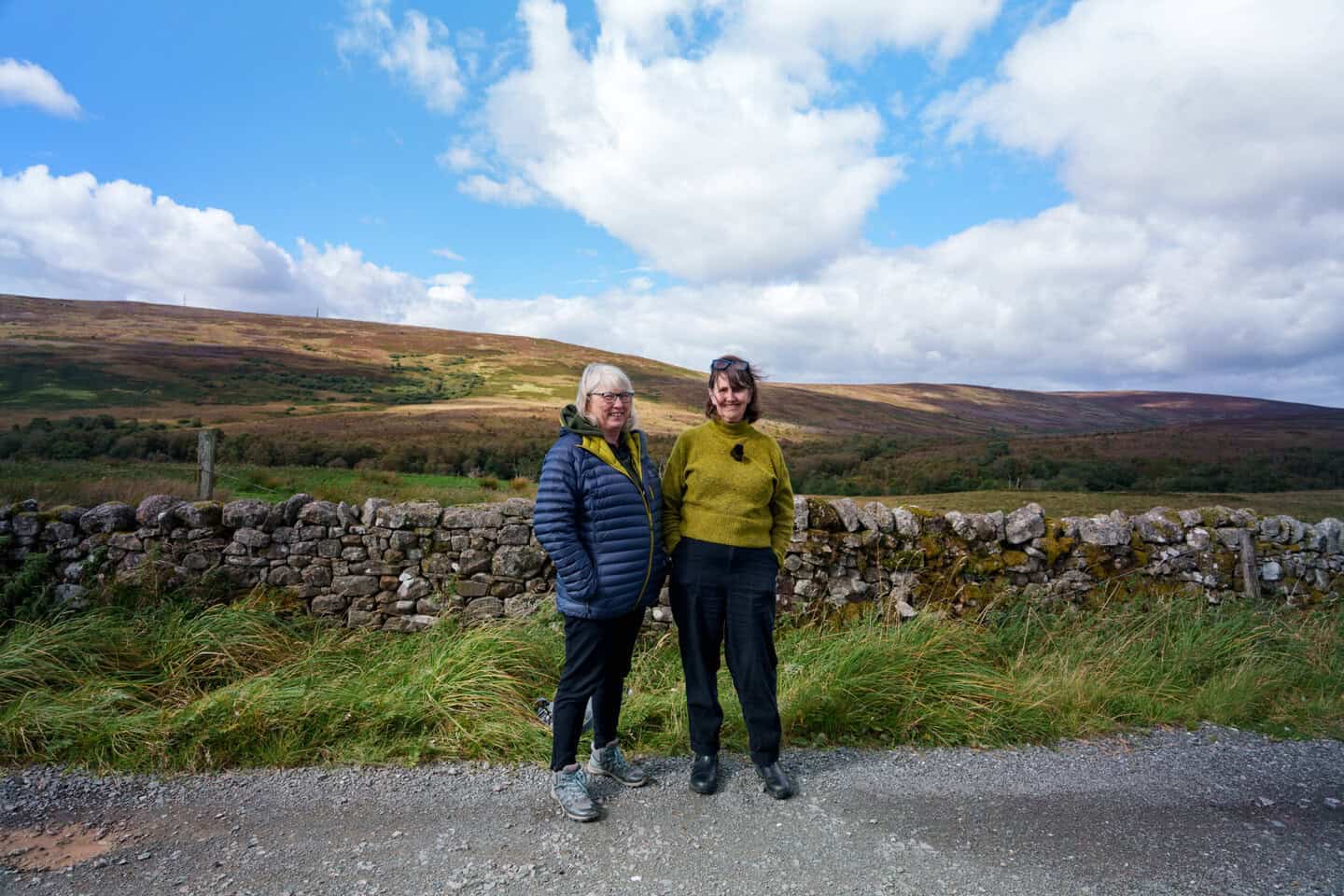
Standing on the Reserve today, looking out over the recovering peatlands and the new native woodlands growing in the gullies, the narrative of “inevitable decline” feels less inevitable.
“This is a forever project,” says Angela. “We hold this land for the grandchildren, and the great-grandchildren. It’s about creating a landscape that is healthier and a community that is wealthier in the truest sense of the word.”
Langholm shows what Community Wealth Building looks like. It is not an abstract theory. It is happening right now, in the peat and the heather of the Tarras Valley, led by a community that refused to let their land be sold, and supported by networks that ensure they never have to stand alone.
Read more from our series This is Community Wealth Building and what we’re calling for to support Community Wealth Building across Scotland.