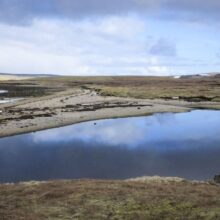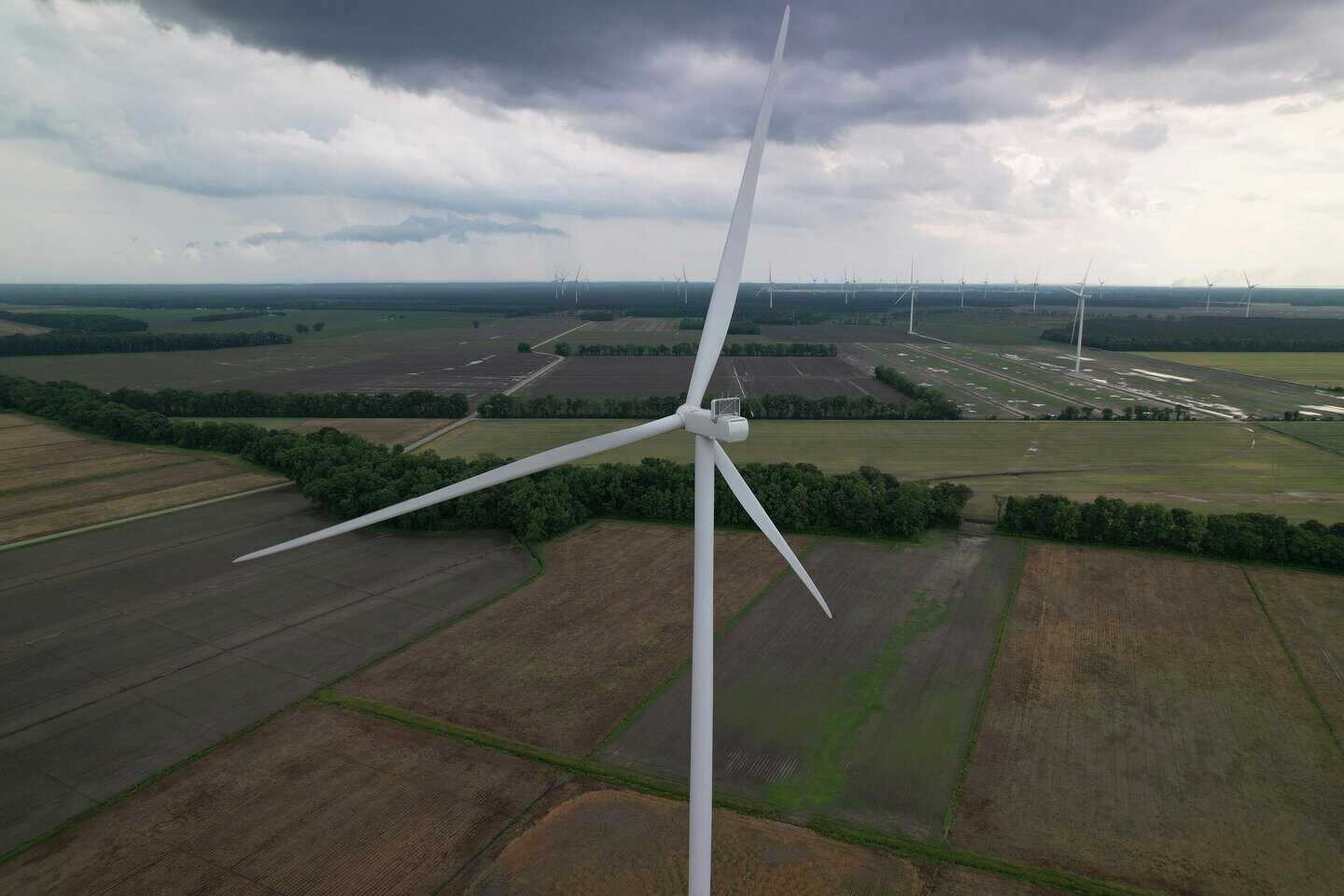
A planning application for the Giants Burn wind farm on the Cowal Peninsula has now been lodged with the Scottish Government.
It is the third attempt to build wind turbines in the area near Dunoon and Sandbank – the others were rejected in public hearings by Argyll and Bute Council.
But because this plan, by the Norwegian state-owned company Statkraft, is for larger turbines, it will be decided in private by the Scottish Government’s Energy Consent Unit.
Already objectors have called for a public meeting, as well as posting out thousands of leaflets.
The Statkraft plan is slightly reduced in size from the initial proposal revealed last year – it is now for five 200-metre turbines and two with a maximum blade tip height of 180m, as well as a battery energy storage system.
In 2010 a plan by Infinergy for 100-metre turbines on the Cowal Peninsula site was decided at a special hearing in Kilmun, where councillors rejected it unanimously.
And previously Cowal Wind Energy Ltd’s plan for the Corlarach wind farm, with 14 smaller turbines 3.4km away, was also rejected by the council.
Follow the link for potential wind farm sites near Loch Lomond and the Trossachs National Park.
Statkraft’s full application is available online here and in Dunoon and Rothesay libraries.

The company said: “The number of turbines and the height has been reduced following engagement during the scoping process and following feedback from our public exhibitions in 2024 and 2025.
“Thank you to everyone in the local community who attended our in-person public exhibitions and visited our online exhibition.”
They said the full application would not be available in Cove Community Library, adding: “Prior to submitting the planning application for Giant’s wind farm, we liaised with the planning department at Argyll and Bute Council to check their preferred locations for public copies, they agreed with Dunoon library and suggested Rothesay.”
Read more: ‘We need a stronger voice’ – 52 community councils on energy future
A community benefit fund for areas including Cove and Kilcreggan would be worth at least £250,000 a year, the developers have said.
In April Statkraft held consultations online and locally over its new proposals for seven turbines: of the 503 responses were received after the consultation, 60% said it was not an acceptable location for a wind farm, 29 said it was and 10 percent were unsure.
Statkraft says that it now expects the application to be decided in summer 2027, with work starting the following year and due to be complete in 2030.
But Gourock Community Council has already decided to object to the proposal, while the Save Cowal’s Hills group is posting 13,000 leaflets via Royal Mail to affected communities within the next week.
A spokesperson added: “The leaflets will clearly advise all on how to object and will also include a direct link (and QR code) for an easy online objection for those who wish to use.
“The group are also hosting a public event in Dunoon Burgh Hall on Thursday 7 August at 7.30pm (tonight) where they will share updates on their campaign, support people re objection submission and spend time engaging with those who attend.
“Save Cowal’s Hills are always happy to hear from those concerned and can be contacted by email on savecowalshills@yahoo.com or via their Facebook page.”
The documents on the Scottish Government website include a scoping report published last year, where three organisations said they were likely to object to a slightly larger version of the plan.
Nature Scot said the site was near to known golden eagle sites and the plan could compromise ‘the ‘overall integrity’ of Loch Lomond and Trossachs National Park.
They added: “Additionally, we consider that the proposal could impact upon the Inner and Upper Firth of Clyde such that it would result in a significant and substantial change to an area that strongly contributes to the distinctiveness, enjoyment, and identity of Scotland.
“This proposal therefore has the potential to result in significant adverse effects on the Loch Lomond and Trossachs National Park which may raise issues of national interest.
“We are supportive of the principle of renewable energy.
“However, we wish to advise at this initial consultation, and without prejudice to any future application, that we have significant concerns regarding potentially significant adverse landscape and visual impacts which are unlikely to be overcome by mitigation, as well as the potential for cumulative effects on the NHZ14 golden eagle population which could raise issues of national interest and impacts on priority peatland habitat.
“Given the extensive history of the site, we consider that it is well established that this is an unsuitable site for wind farm development.
“As such, it is very likely that NatureScot would object to a wind farm development, of any scale, in this location.”

The Joint Radio Company (JRC) also objected, as well as air traffic organisation NATS, which said it was likely to cause false primary plots to be generated as well as reducing the RADAR’s probability of detection.
A separate planning application for a 120-metre high meteorological mast on the Giants Burn site was submitted to Argyll and Bute Council in January – so far there have been 106 objections and two comments in support.
Cowal ward Cllr William Sinclair said he had been to three community meetings on the issue, where ‘all were really concerned’ – at two of the meetings there had been a show of hands, where 100% of those present were against the plan.
He said the plan was ‘entirely inappropriate’, adding: “This mast is totally out of place in this landscape. Any impact on tourism will have a lasting effect on Cowal’s fragile infrastructure.”
He raised concerns about damage to peatland and disturbance to birds, adding: “Let’s be absolutely clear that this is a planning application which is directly related to a wind farm site and nothing else.
“Members of this community are simply not happy and must be listened to.”
Ecologist Dr Neil Hammatt also objected, saying: “I am unaware of any similar areas of such habitat on Cowal which is so well preserved.
“Elsewhere in the area, hilltops have been converted to grassland by intense over-grazing, and erosion and disappearance of deep peat.
“In fact, the vast majority of all habitat on Cowal in a very poor state for nature.
“Any disturbance to the vegetation and underlying peat by wheeled vehicles will have immediate consequences for the quality of habitat used by a likely complex community of plants and animals, and also the peat, especially if it leads to a more rapid run-off of rainwater down tracklines.”
Details are on the council’s website – the reference number is 24/01926/PP.

This article is part of The Power Shift – a collaborative investigation by ten independent, community-based publishers across Scotland, exploring the impact of the green energy transition on communities. Supported by the Tenacious Journalism Awards, the project aims to amplify local voices, facilitate cross-community learning and push for fair, transparent energy development.