But who will pay for it and at what cost?
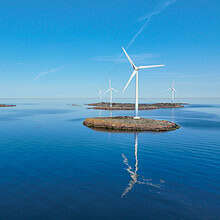
Renewable energy development in Lewis is not new, but the potential scale of commercialisation is. Community-owned estates, trusts and local businesses have operated a small number of profitable wind turbines for over a decade and many of them have plans to increase investment in this area.
However, the combination of the Scottish Government’s ScotWind leases – granting rights for offshore wind projects – and planning approval for Scottish and Southern Electricity Network (SSEN)’s 1.8 GW Stornoway-Ullapool interconnector has accelerated several proposed commercial developments.
Currently, alongside the intensive, large-scale construction work required to develop the substation for the new interconnector at Arnish in Stornoway, there are ten windfarm projects that are proposed for either offshore or onshore development.
Only one of these has broken soil, but if all these projects reach the construction and the operational stage, a maximum of approximately 300 wind turbines could be installed. These will have the predicted potential to generate enough electricity to supply millions of homes – although not the homes from which the windfarms will be seen.
With these projects at varying stages – and many still awaiting access to the interconnector and, by extension, the National Grid – it is difficult to predict if, when, or how all will reach construction.
Equally challenging is anticipating the full impact of such large-scale development on the Isle of Lewis’s urban and rural communities, both economically and socially. Yet understanding these effects is not enough; careful logistical planning and targeted investment are essential if the benefits are to outweigh the drawbacks.
In a report last July, the Stornoway Gazette published that an estimated 1,500 additional workers would have to move to the island during the construction phase of the windfarm projects (if they all reach development). With the majority of commercial projects being run from, or developed within close proximity to, Stornoway, this would mean an approximate 22 percent increase in the population of the Stornoway area over a condensed period.
Such an influx will of course, for a few years, increase the economic viability of many local businesses. Private landlords, hotels and the leisure and entertainment sector will generate a considerable income from the new residents, but only of course whilst construction is ongoing – 1,500 workers will not be required to maintain the new windfarms.
The first development to break ground – Stornoway Wind Farm – is being developed by Lewis Wind Power, a 50:50 joint venture between EDF Power Solutions and ESB Energy.
This development is employing local contractors to work on site but will require a larger work force as the development progresses. In an article published online by the The Scotsman, it was reported that one of the ‘workers’ camps’ being planned for development in the Willow Glen area of Stornoway would be used for contractors working on the Stornoway Wind Farm. A spokesperson for Lewis Wind Power commented in February: “We have been working with Balfour Beatty and SSEN on a joint solution to provide temporary worker accommodation near to Stornoway. Our proposals are still being finalised at this stage.”
SSEN’s substation development will also require accommodation for their initial wave of workers and the increased frequency of recent public announcements from them is indicative that are focused on this. Towards the end of last year, they confirmed they would invest in the construction of up to 94 new homes at the Stornoway Airport Housing Development. The homes – expected to be completed by the end of 2027 – will initially accommodate workers involved in the construction of SSEN Transmission’s projects but will then be made available to the local community as affordable housing.
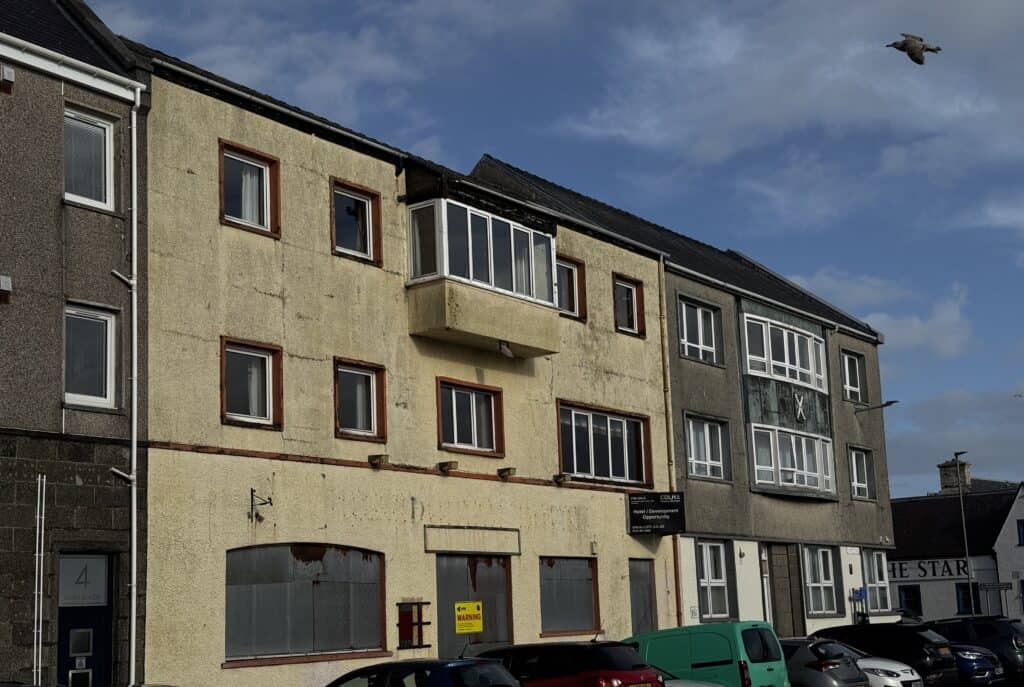
SSEN have also invested in the renovation of Stornoway’s Caledonian Hotel or ‘The Caley’ as it is known locally. The new owners of the premises, the MacArthur family, have been developing and operating accommodation businesses locally over three generations and plan to keep the hotel open post construction development. In addition to this, SSEN are funding the construction of a temporary ‘Workers’ Camp’ planned for development next to the other temporary site in the Willow Glen area of Stornoway. This will provide accommodation for an additional 200 workers.
Understandably, from an SSEN perspective, their accommodation investment is Stornoway-focused – why locate your workforce in a rural area, further away from transport connections and the construction site? But here lies one of the major economic concerns with the industrialisation of Lewis. The economic benefits from the increased population of transient workers will sit within the town of Stornoway.
SSEN have a thirty-minute-travel rule for their workforce for accommodation to work. They are, however, also considering investing in rural housing developments that sit within that boundary – albeit on a smaller scale, and in a manner that is nuanced and balanced with the future needs of the rural community.
Urras Oighreachd Ghabhsainn (UOG), a community-owned estate in the north of Lewis that generates income from three Enercon 900 kW wind turbines connected to the grid through the existing interconnector between Harris and Skye, has been focused on providing affordable housing to retain and attract a younger demographic, whilst also supporting the needs of an ageing population. It is this focus that, in 2017, led to them entering discussions with the local council Comhairle nan Eilean Siar (CnES) Hebridean Housing Partnership (HHP), and NHS Western Isles to develop a combined housing, care and community facility in Upper Barvas.
Due to funding constraints at the time, the project was unable to progress. However, with the future demand for SSEN workers now confirmed, and the fact that Upper Barvas meets the ‘thirty-minute-travel rule,’ an investment opportunity has arisen. As Jemma MacVicar, executive manager of UOG explained:
“We have been in discussion with Scottish and Southern Electricity Networks (SSEN) regarding the potential to benefit from their Housing Legacy Fund. SSEN’s current proposal presents an opportunity to reinitiate development, beginning with the construction of eight three-bedroom homes. Establishing housing on the site, alongside the introduction of supporting services, would strengthen the long-term viability of delivering the future care phase of the project.
“Discussions to-date indicate that an offer of a percentage capital funding towards construction is conditional upon Balfour Beatty leasing the properties to accommodate its workforce during the construction of the interconnector infrastructure between 2027 and 2030. From 2030 onwards, the homes would transfer to community use and be made available through a range of affordable tenure options, including rent, shared equity, or sale.”
These investments and discussions are starting to address the demand for accommodation that SSEN needs to meet for their workforce, whilst also supporting a housing legacy. But what of the other companies? Will they too start to invest in accommodation in a way that supports the communities of Lewis in the future – beyond the construction period? Or will their workers’ presence lead to a further increase in property prices and reduction in local rental availability? And, crucially, what about the other key infrastructure and social pressures that an additional 1,500 residents will bring?
Some of these questions will not be answered until the larger projects are successful (or not) in the planning application process, and although other areas such as emergency services provision, community safety, healthcare, transport and food provision are being discussed by the CnES-led ‘Major Development Oversight Board.’ Planning, finance and action are needed for statutory and non-statutory services. As are communication and reassurance to the current residents of Lewis.
Earlier this year, CnES balanced their £5.4 million deficit by removing funding for the arts and culture, increasing council tax by 8.5 percent, using returns from investments, uncommitted reserves and savings from service budgets. This leads to a question that has been asked before: how will the actions identified by the Major Development Forum be financed?
The different windfarm developments all have different approaches to community benefit packages. Some, such as Lewis Wind Power, have an established history of sponsorship provision and are also now investing in the local workforce by funding apprenticeships. Others such as Spiorad na Mara (N4) (Northland Power) were negotiated with The Westside Estates Group to commit £4.5 million every year, index-linked, for the operational lifetime of the project – if it becomes operational.
Community benefit packages are not, however, designed to be used on statutory services and nor should they be. So once again, and as we rapidly approach the upcoming Scottish Parliamentary elections, the question needs to be asked: where is the money coming from to support the statutory infrastructure in the Western Isles, if all, or even a percentage, of the proposed windfarm developments reach the construction phase?
The UK Government has recently announced £1 billion of funding as part of the Local Power Plan to support community energy projects in different ways, many of which, at this stage, are open to discussion and innovative applications but not for statutory services. Recently, during his visit to The Point and Sandwick community-owned wind farm at Beinn Ghrideag, Fios was able to ask Michael Shanks, UK Minister for Energy, how reassurance can be given to the community of Lewis with regards to the social and economic pressure of a 22 percent population rise in the Stornoway area as a result of windfarm development. He responded:
“We should be seeing genuine community benefits from these things being built in people’s communities. It is a service being done for the country, this infrastructure, and so there should be some genuine legacy from it… But that wider investment in services is obviously for the Scottish Government to settle. Government budgets and local government budgets have suffered cuts after many, many years. But, the Scottish government budget has increased by more than £9 billion, so we should be seeing that investment coming through. There’s a formal planning process that goes along with these applications, but there’s also a much less structured process around how we actually make these workers come in to build these things, have the services they need and that it doesn’t detract from wider investment that is needed in public services.”
It is evident that when financial resources are available, decisions can be made and actions taken. As this article was being written, SSEN announced that they have secured a dedicated vessel, the MV Arrow, to transport construction materials and project freight, thus safeguarding the already problematic public ferry service. The vessel will also be available to be used by others, when not required by SSEN Transmission. It is also evident that when given autonomy and support community owned energy groups can generate sustainable levels of finance and community wealth.
The escalation of announcements surrounding the impending development work in Lewis adds further to the vast quantities of complex information that current residents are having to process – if they want to understand how their communities will be affected by the scale of construction that is going to take place in Lewis over the next five years.
Some residents will benefit socially and economically from these developments, but some will not, and as a Shetlander recently told me: “The workers do not stay forever, and when they leave, so does their money.”
This article is from our print magazine The Power Shift.
If you would like to receive a copy of The Power Shift magazine, you can order online here.
If you are interested in joining the new Environmental Journalism Network that is open to journalists, campaigners, researchers and experts, sign up here.