Arriving with Mainland Eyes
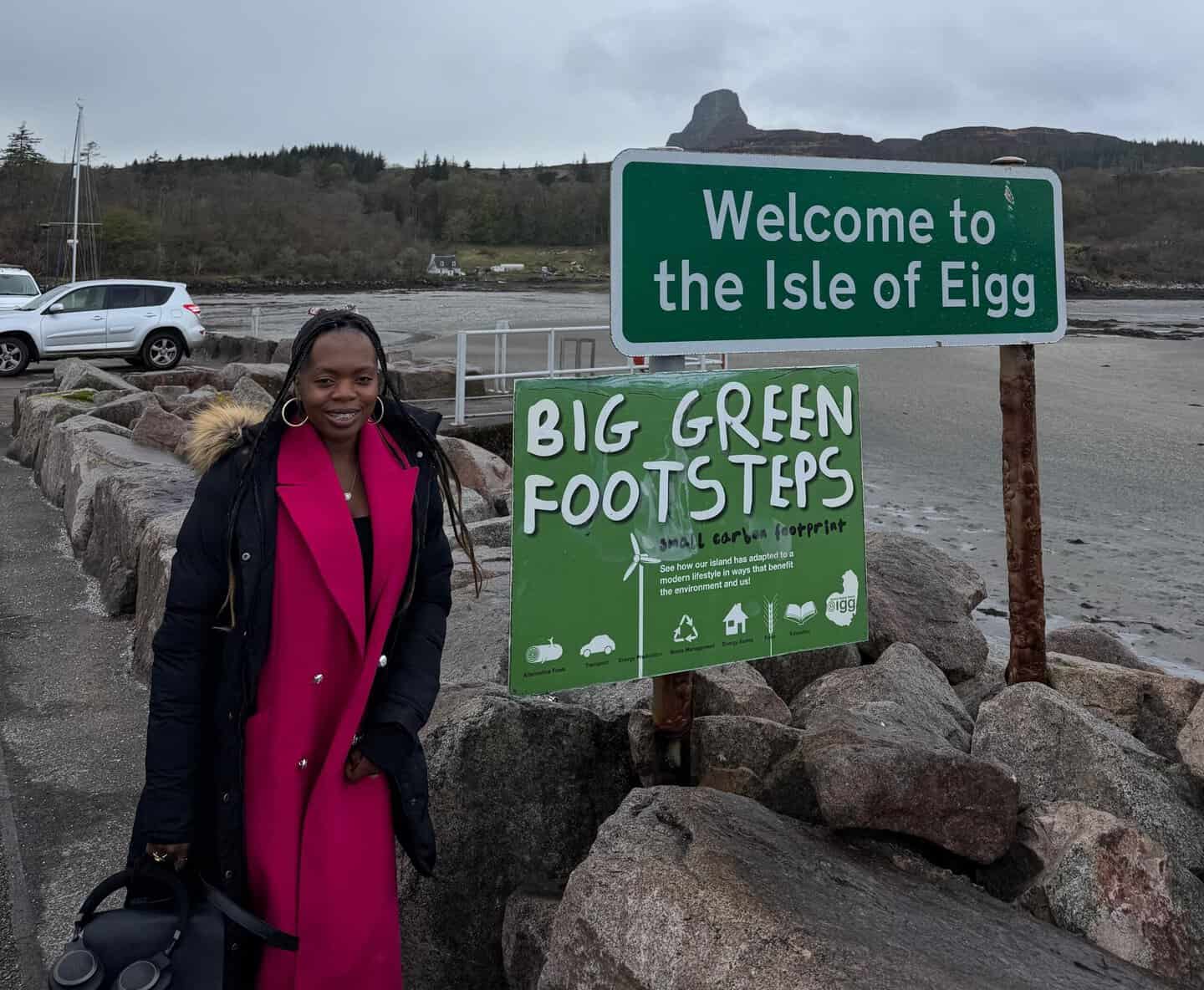
Having grown up in Rwanda, my only reference for island life was Nkombo in Lake Kivu. It’s just as crowded and integrated as the rest of the country, so I expected the Isle of Eigg to follow suit. I quickly realised how wrong I was.
Before setting foot on the Isle of Eigg, my perception of sustainability was highly influenced by theories, policy frameworks, scientific and technological innovations, and the global narratives of green transition and net zero goals. It was my first time experiencing life on a remote island. I had come to associate sustainability with systems that prioritise efficiency, scale, and convenience. On the mainland, energy is constant, food is abundant and imported, and consumption is rarely constrained. Sustainability, in this context, sometimes appears as an add-on rather than a fundamental restructuring of everyday life.
Visiting Eigg disrupted these assumptions. Rather than an optimised system driven by expansion, I encountered a model grounded in limits, local resources and collective responsibility. As an island, Eigg functions as what scholars describe as a “natural experiment” a bounded space where alternative systems of living can be observed more clearly. Its geographical isolation creates both constraints and opportunities, making sustainability not an abstract goal but a lived necessity.
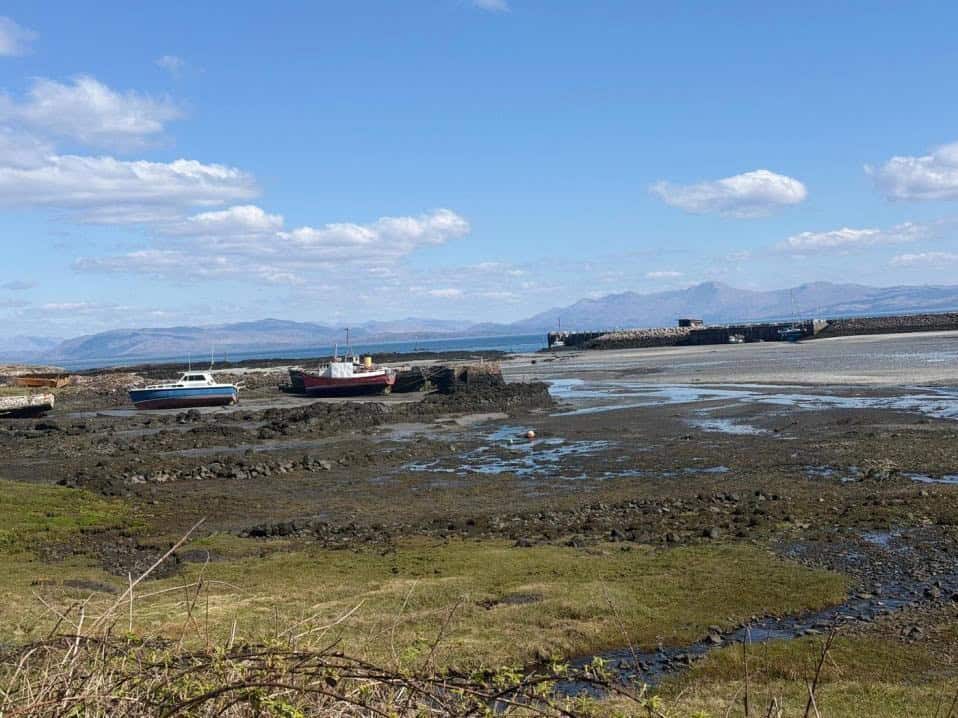
Galmisdale Bay pier at low tide, looking out toward Rum and the mainland. The pier is the only entry point to the island (author’s photo, April 2025).
As per the census of 1841, the population on the isle was at its peak number of 546. This inevitably brought food security issues in the following years. Due to this, as well as aging population many of the crofts were abandoned in the early 20th century. Less crofts being maintained leads to even bigger issues for sustainability.
As the island is isolated from the UK, a new innovative approach was required to bring the Isle back to life. In 1983 the local community formed association to tackle the issues, which led to the community buyout in 1997 by the Eigg Heritage Trust. Since then, the island has been self-governing and all decisions about development, infrastructure and management are made by its residents. Such structure represents a collective controlled system rather than global complexity.
Stepping off the ferry, this history was not intangible, it was visible in the repaired pier, the community-owned shop, the absence of cars belonging to outsiders. Eigg’s isolation does not make sustainability easy; it makes it unavoidable. That is the experiment I had come to observe
Caring for the Land: Tree Planting, Food Security, Land Ownership and Crofting
On Eigg, sustainability is not theoretical. It is practised on the land. Residents grow food, plant trees, and manage crofts under a system of land tenure rooted in centuries of struggle. What I saw was a slower, more patient form of care, provenance recorded tree by tree, vegetables grown steps from the kitchen, and a legal framework that ties people to the soil.
Raised vegetable beds beneath the basalt cliffs of Cleadale: small-scale food production at the heart of crofting life (author’s photo, April 2025).
At the Eigg Tree Nursery, our guide Tasha explained that every tree they grow is given a number, and that number corresponds to a spreadsheet identifying the exact street it was collected from.
Each order is accompanied by a “Masterpiece Certificate” tracing its provenance.
“We’re really hot on bio-security,” she said. “We’re really fortunate as an island, we have very little tree disease at the moment, and we want to keep it that way.”
What looked like a small operation was in fact a careful infrastructure of recognition; the land remembered, traced, named.
The aspen story stayed with me longest. To flower and set seed, aspens need around 15 genetically distinct individual trees, but Eigg’s aspens are clonal; root suckers from the same individual. So Tasha is collecting aspen roots from across Scotland, slowly building a genetically diverse grove.
“Aspen, our only native poplar, is on the brink of extinction in Scotland. It is a slow project for a future generation,” she added.
The locals take sustainability as a way of life, this is most prominent in everyday acts of consumption, what people eat, grow and use.
Let’s start with food security; most of the vegetables and fruits are grown locally in individual small crofts and from some local initiatives like Eigg Organics. The meat on the Isle is produced from a rare breed of Soay sheep, eggs are gathered from free range chickens. By producing some vegetables locally, there is lower carbon footprint daily food transportation is limited. On the other hand such practices reduce the variety of products available to consumers.
The local resident’s habitat is a special kind of land tenure called crofting, which is something that is found most exclusively in Scottish Highlands and Islands. It is something that has deep root in Scottish history. The tenants are required to live close by their crofts and are responsible for looking and caring for its land and relies heavily on its produce. In case the land is not maintained, it can be considered abandoned and the tenant may be evicted. Thus, making it labour intensive.
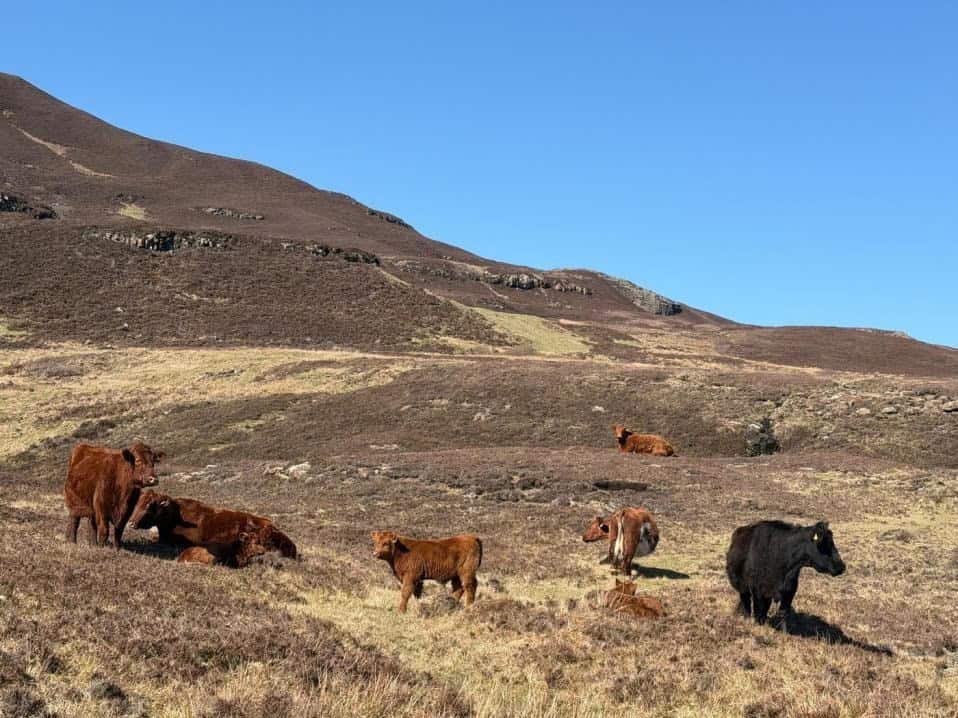
Cattle grazing on heather pasture in Cleadale. Crofting on Eigg has traditionally focused on cattle rather than sheep (author’s photo, April 2025).
The local economy is also supported by making willows for baskets and coffins using renewable materials, as well as drinks produced by the local brewery.
What seems sustainable on Eigg means less convenience and choice ; easy at small scale, much harder to apply globally.
Five Kilowatts Is Enough : Energy and the Politics of Limits
The 170kW photovoltaic array on the south-facing hillside above the Control Building. One of three renewable sources powering the island (author’s photo, April 2025).
Eigg Electric, community-run since 1997, powers the entire island sustainably. which included a 100% renewable grid with a total of 308kW electricity generation from renewable sources. Then system consists of:
- Hydropower: 112kW
- Wind Turbines: 24kW
- Solar: 170kW
- Hydrocarbon (backup): 128kW
The supply of the island is completely disconnected from the UK and does not receive any electricity, all energy on the Isle is home generated. To ensure that there is enough power for everyone (both households and businesses) the Isle trust has enforced energy usage caps:
- 5kW per household
- 10kW per commercial property
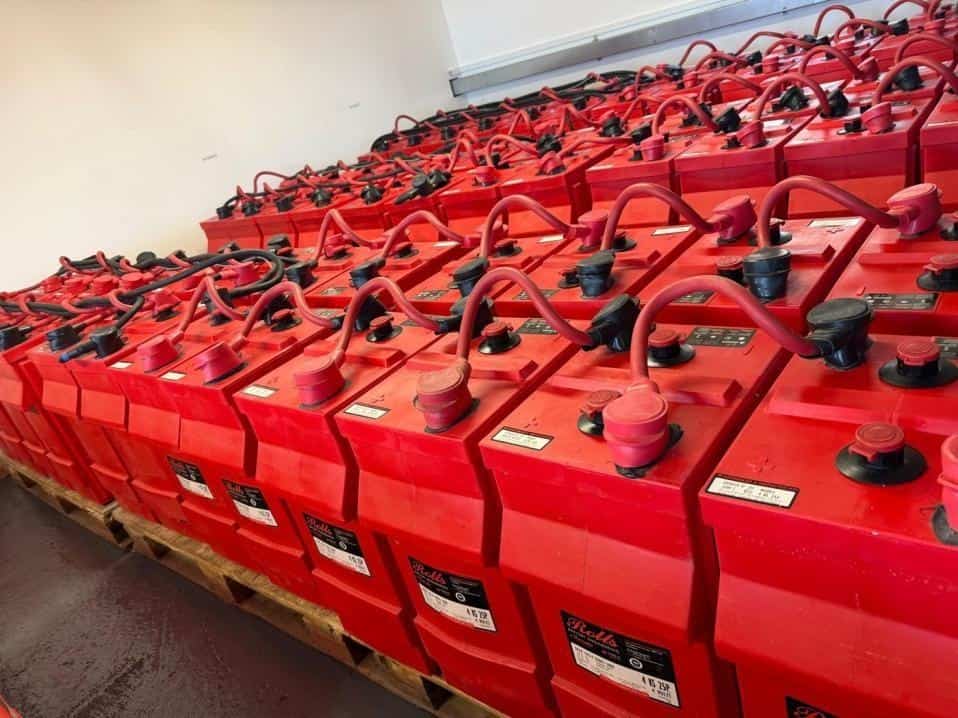
Ninety-six 4-volt batteries inside the Control Building, capable of powering the entire island for up to 24 hours (author’s photo, April 2025).
According to scholars, in 2015 there were 38 households and 5 commercial properties. This means that the maximum electrical load on the grid during 2015 was 240kW, which is 68kW less than the theoretical maximum load of 308kW. We were told that sometimes wind and solar energy are not guaranteed due to variable factors like weather conditions. This leaves the population of the island relying on Hydropower and Hydrocarbon generation.
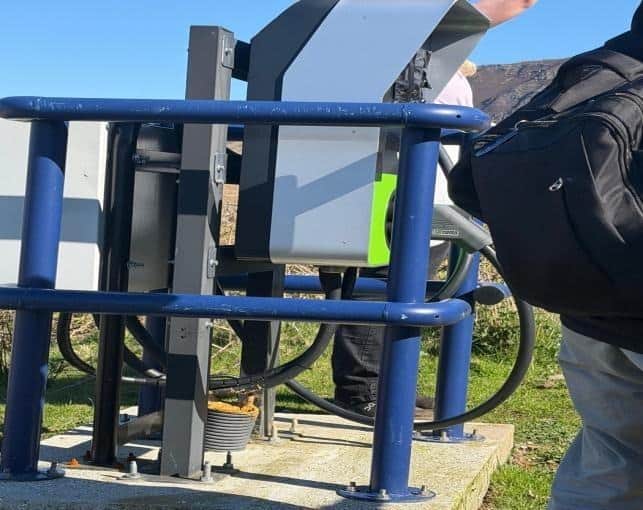
An EV charging point near An Laimhrig — the island is preparing to meet its 2030 carbon net-zero target (author’s photo, April 2025).
Unlike mainstream energy transitions that seek to maintain high consumption through cleaner sources, Eigg’s model enforces limits challenging the assumption that sustainability can be achieved without reducing demand. According to OFGEM data, a regular medium household (2-3 people, 3 bed house) uses approximately 7.33kWh per day. This far exceeds the limitations that have been imposed by the trust. If the limit gets exceeded fines are imposed. This shows that households or businesses must significantly reduce their usage. Also, according to European Commission, full energy independence has not been achieved as the local population still relies on use of hydrocarbons for heating, cooking, and alike. The use of such requires the importation of fuel, from mainland. As there is still reliance on external sources, absolute energy independence is not yet achieved.
Can this be achieved in large urban areas? In theory, relatively yes. In practice, the barriers are political as much as technical. Cities consume far more energy per capita than Eigg and depend on systems built around constant availability. Copying Eigg’s model would require not just renewable infrastructure but a fundamental cultural shift. One that demands limitation rather than efficiency. Without community consent to such limits, urban “transitions” risk reproducing the very highconsumption patterns they claim to replace.
A Blueprint or a Provocation? Environmental Justice, Participation and Scale
While Eigg is often celebrated as a sustainability success story, it is worth asking whether such models are universally accessible or context-dependent. Central to Eigg’s model is participation not as a symbolic gesture, but as a governing principle embedded in ownership. The island operates a form of direct democracy where major decisions on land use and infrastructure are taken by the community.
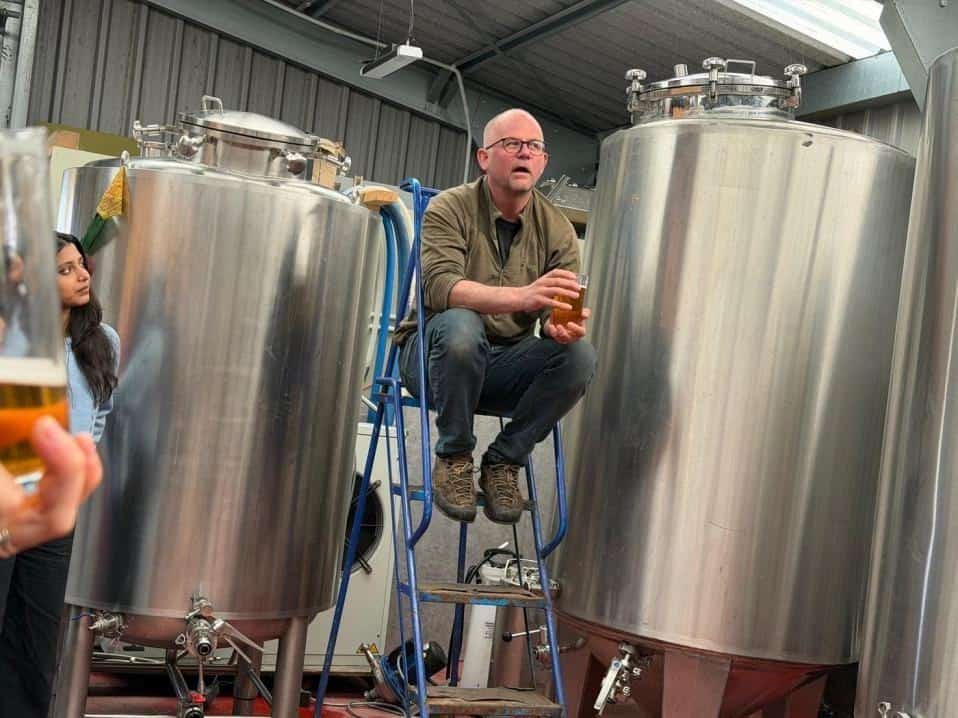
The brewer talking to our group during the tour. Crofts and small businesses on Eigg are tightly woven into community life (author’s photo, April 2025).
But why does it work?
Partly because the population is small around 110 people meaning individual voices carry weight. This raises an important question; can democratic sustainability exist at scale, or does it depend on intimacy? Procedural justice requires participation, but recognition justice reminds us that not all voices are heard equally .Even on Eigg, the Crofting Plan notes five crofters are currently absent. Participation has limits.
There is also a what scholars call Malthusian danger (blaming population, often the poor, for problems caused mainly by overconsumption). Eigg works partly because it is small, but smallness alone is not a global solution. As Monbiot argues, focusing on population lets wealthy consumers off the hook. Eigg does not offer a blueprint, but a provocation; true sustainability may require restraint, not scale.
This article has been written for The Scottish Beacon through a collaboration with Pass The Mic – an organisation which aims to tackle the under-representation and misrepresentation of women of colour in Scotland’s public life and media.