
As Scotland’s first generation of wind farms approaches the end of its working life, researchers are arguing that the next phase of renewable energy development could become one of the country’s biggest opportunities for community ownership.
A new report from Equitable Energy Research CIC, Onshore wind repowering opportunities for Community Wealth Building in Argyll and Bute – and beyond, says repowering existing onshore wind farms – replacing older turbines with larger, more productive technology – could help shift ownership of renewable energy assets into the hands of communities and local authorities.
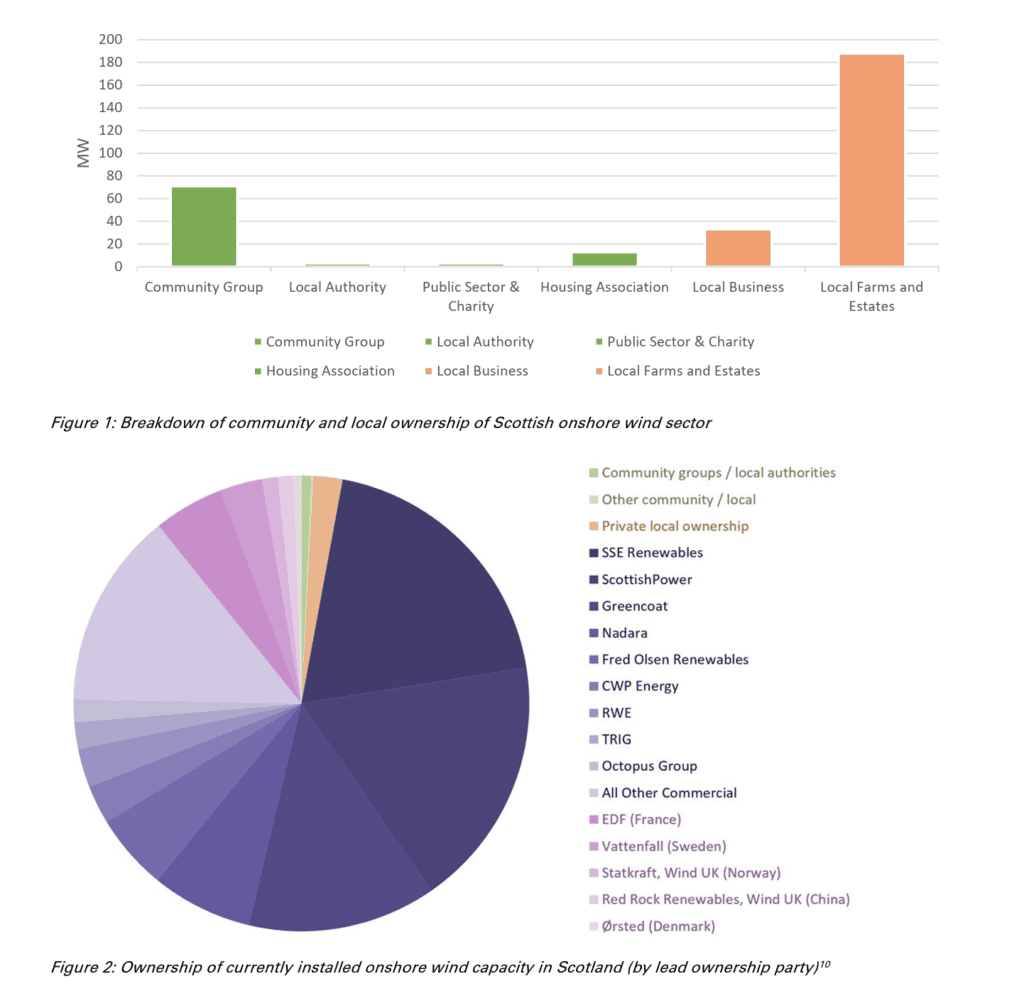
The argument comes at a pivotal moment for Scotland’s energy transition. While the country is often presented as a renewable energy success story, less than 1 percent of Scotland’s onshore wind generation is currently owned by communities or local authorities, according to the report. The overwhelming majority remains in private ownership or is controlled by state-backed companies based outside Scotland.
Ownership of onshore wind in Scotland today – taken from the report
The findings speak directly to questions at the heart of The Power Shift, our ongoing collaborative investigation into who benefits from Scotland’s renewable energy boom, how ownership of land and energy is changing, and whether communities are securing a meaningful share of the wealth being created.
The report’s authors argue that repowering could provide a rare opportunity to address that imbalance. As older wind farms come up for redevelopment, communities and local authorities could be given priority access to projects on public land, allowing more of the long-term economic benefits to remain in the places where energy is generated.
The report follows the introduction of the landmark Community Wealth Building (Scotland) Act earlier this year, which places new duties on public bodies to consider how ownership of land, energy and other assets can be diversified through community ownership.
Researchers point to publicly-owned land as a particularly important opportunity. They welcome a Scottish Government pilot scheme that gives communities priority access to ten wind farm sites on the Forestry and Land Scotland estate as they come up for repowering. However, they argue the pilot covers less than a fifth of the estate’s total generating capacity and should be expanded more widely.
Argyll and Bute is highlighted as a potential test case. The area hosts some of Scotland’s oldest wind farms and includes three Forestry and Land Scotland sites – An Suidhe, A’Chruach and Beinn an Tuirc III – that could become candidates for community-led repowering projects.
The report also calls for reforms to grid connection rules and greater financial support from both the Scottish and UK governments. Without easier access to finance, technical expertise and grid capacity, the authors argue, communities and councils will struggle to compete with commercial developers.
Equitable Energy co-founder Erin Rizzato said political support for community ownership was growing, but that action was needed if Scotland was to turn ambition into reality, saying:
“The recognition of how important it is for energy to be in the hands of communities has never been stronger.
“Repowering presents a once-in-a-generation opportunity to ensure that the benefits of Scotland’s energy stay in Scotland and support the wellbeing of communities struggling with fuel poverty and some of the highest energy bills in the UK.”
She described wind farm repowering on public land as one of the clearest opportunities available to diversify ownership of Scotland’s energy system.
Ailsa Clark, founder and executive director of InspirAlba, said the issue was particularly significant in Argyll and Bute, where communities continue to experience high energy costs despite hosting major energy infrastructure:
“The report highlights the opportunity for Argyll and Bute to be a test bed for increased community and public ownership of onshore wind through repowering.
“This would enable a fairer distribution of wealth away from a wealth extraction model towards a community wealth building model.”
Pauline Smith, chief executive of the Development Trusts Association Scotland, said community ownership was about more than generating income: “It is about giving communities control over the assets that shape their local economy, environment and future.”
As Scotland prepares for a new wave of renewable energy investment, the debate over repowering raises a broader question: who will own the infrastructure powering the country’s net-zero future, and who will benefit from the wealth it creates?