Published in partnership with The Herald
As commercial windfarms are being lined up for development in and around the Western Isles – and plans evolve for the onshore infrastructure to support some of them– concern and speculation about how, or if, the communities affected will benefit from the ‘Hebridean Wind Rush’ is growing.
In August last year Spiorad na Mara announced that as part of their proposed offshore development along the west coast of the Isle of Lewis, they would be committing to an annual £4.5 Million community benefit package. This index-linked fund, negotiated by the West Side Estate Group (WSEG) and unprecedented in scale at the time, has now gone through an independent public consultation process, with the full report by Aquatera being published last week.
The potential of such community benefit is welcomed by many – if developments of this scale are to take place, then a financial benefit to the communities affected should, it is argued, be front and centre in the process.
For some however, no amount of money can replace what they feel they will lose from the major developments being planned. If the project goes ahead, Spiorad na Mara will be located approximately 6-13 km off the west coast of the Isle of Lewis. The close proximity of this location to the shoreline has created polarised opinions within local communities and with the proposed number and height of the turbines ranging from either 60 at 294 metres or 44 at 359 metres, it is not hard to understand why.
However, opposition to development from residents in these communities is not about opposition to renewable energy. One of the areas affected – Galson Estate – became community owned in 2007, instigated, in part, in protest to plans for an industrial scale, onshore windfarm proposed by commercial developers – AMEC.
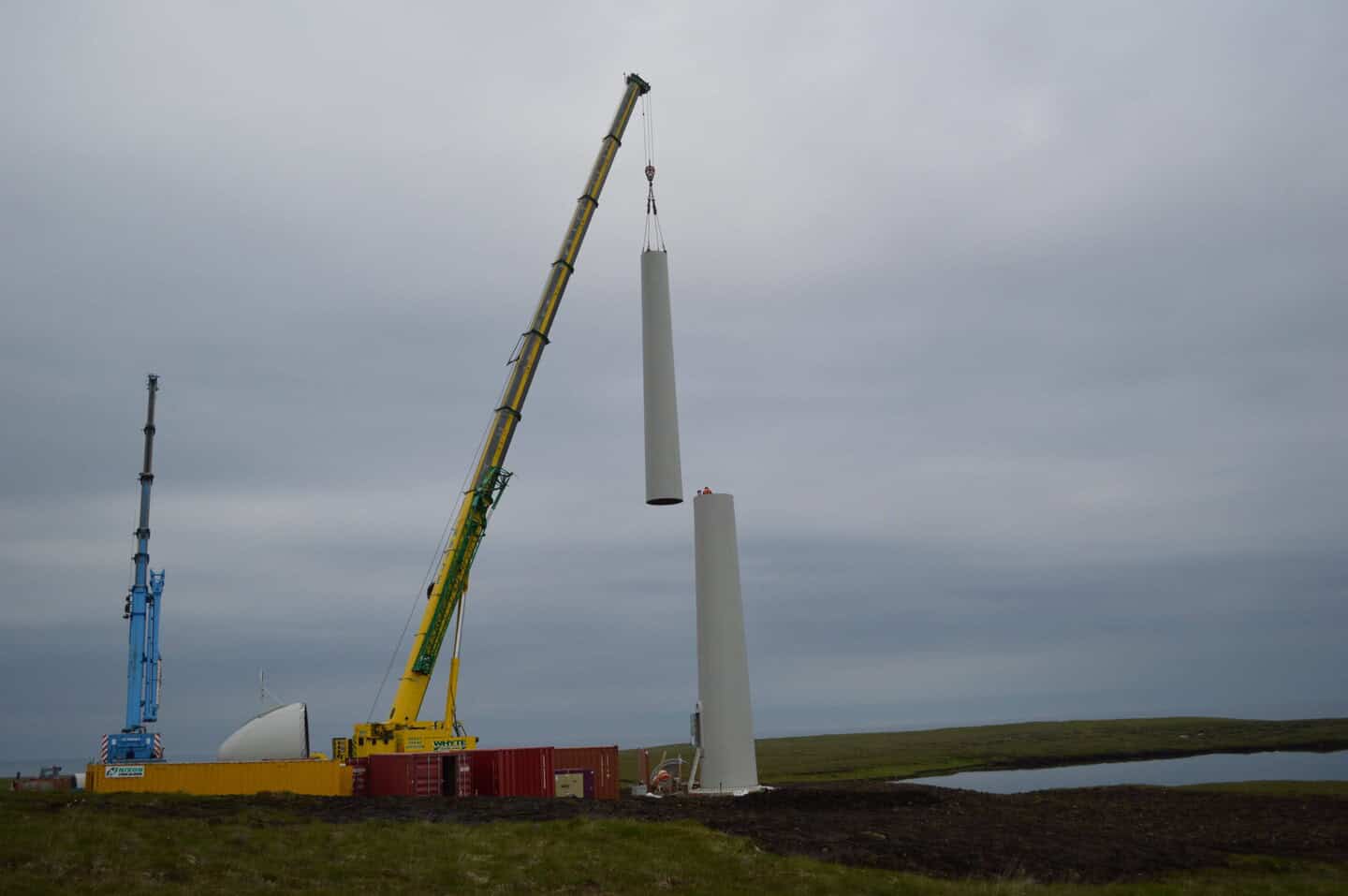
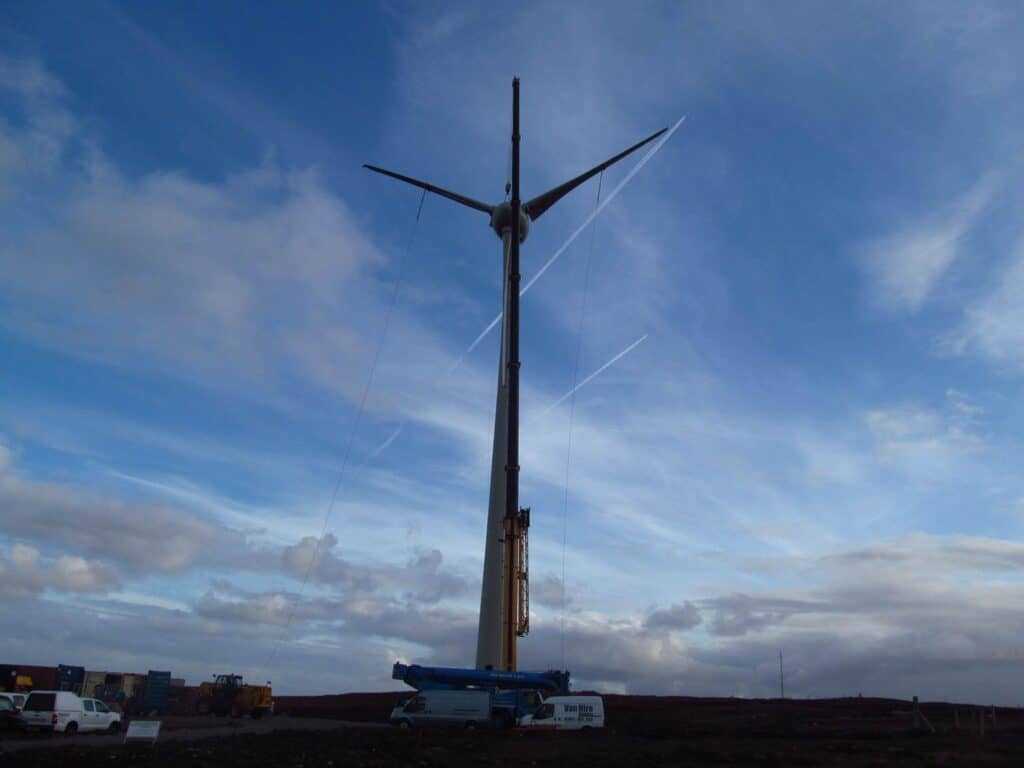
The estate, managed on behalf of the community by Urras Oighreachd Ghabhsainn, (UOG) now receives income from three Enercon 900kW wind turbines connected to the grid through the existing interconnector between Harris and Skye – the first of these was installed in 2013 and the latter two in 2015.
These three turbines generate, on average, 8,871 MWhs per annum (in total) and crucially, over ten years later, supply an income to the estate that supports up to eighteen employees, has contributed £600,000 to community organisations (through their community investment fund) and provides a cohesive, physical foundation upon which the future needs of the community can be built.
At the same time, a consortium of three community landowners on the west side of Lewis referred to as West Coast Community Energy – of which UOG is part of, are soon to go through the planning process for a new, onshore windfarm. The income from this development will be re-invested within the community.
It is fair to write, therefore, that residents of the Western Isles don’t just understand the benefits of speculating on the wind in the Hebrides – some have the mechanisms in place to plan, build and run developments at a scale that are in harmony with the surrounding environment and population.
To generate income, however, they need to maintain and increase their ability to export electricity to the national grid. And yet, as the ‘Hebridean Wind Rush’ picks up pace and as global energy companies secure space on the new 1,800MW SSEN Interconnector (planned for development between Stornoway and Ullapool), the community energy companies based on the Isle of Lewis have been pushed out of the marketplace.
In a recent article by Fios, as part of the Scottish Beacon ‘Power Shift’ project, we reported that of the projects listed below (see TABLE 1) none are community-owned windfarms (although there is one community-owned battery project that has secured 25MW of the 1,800MW capacity). It is important to point out here that permanent space on the interconnector is crucial both to export the electricity generated by windfarms, and to secure investment for development.
| TABLE 1: CURRENT DIVISION OF MW CAPACITY PER PROJECT, FOR THE NEW 1,800MW SSEN INTERCONNECTOR (STORNOWAY – ULLAPOOL). | ||
| PROJECT NAME | COMPANY NAME | CAPACITY (MW) |
| BATTERY POINT BESS | POINT AND SANDWICK POWER LTD. | 25 |
| DRUIM LEATHANN BEGA | DRUIM LEATHANN WINDFARM LTD. | 49.7 |
| GRIMSHADER WIND FARM | RWE RENEWABLES UK ONSHORE WIND | 79.2 |
| HEASTABHAL WIND FARM | RWE RENEWABLES UK ONSHORE WIND | 66 |
| MUAITHEABHAL WIND FARM | UISENIS POWER LIMITED | 189 |
| SPIORAD NA MARA OFFSHORE WIND FARM | SPIORAD NA MARA LIMITED | 900 |
| STORNOWAY WIND FARM | STORNOWAY WIND FARM LIMITED | 180 |
| MAGWIND | MAGNORA OFFSHORE WIND AS | 495 |
| TOTAL | 1,983.9 | |
| NOTE: THE TOTAL CONFIRMED CAPACITY IS CURRENTLY ABOVE THE 1,800MW. IT IS ANTICIPATED THAT THIS WILL BE REDUCED TO 1,800 AS PROJECT PROPOSALS ARE ADJUSTED. THESE FIGURES WERE GENERATED FROM INFORMATION RECORDED IN JUNE 2025. | ||
Since our report in August, developments have taken place and both community energy projects featured in the report – UOG (as part of the West Coast Community Energy Project) and Knock and Swordale Community Energy company have been awarded £179,000 and £62,000 respectively, through a combination of Scottish Government and Great British Energy funding via the Community and Renewable Energy Scheme’s (CARES) Community Energy Generation Growth Fund.
In addition to this in a letter to the Stornoway Gazette, SSEN Transmission has confirmed that it is committed to supporting community energy developments, questions have been raised directly with Michael Shanks Minister of State for Energy and recently the Development Director at Point and Sandwick Trust – Calum MacDonald gave evidence at the Energy Security and Net Zero Select Committee as part of its inquiry into Unlocking Community Energy at Scale. An update on the much-needed confirmed space on the interconnector, however, will not be available until 2026.
In the meantime, there has been a flurry of headlines detailing financial investment to support the commercial onshore and offshore wind farm developments within the Western Isles.
At the beginning of November, it was confirmed that a road connecting the Arnish Industrial Complex and Stornoway Deep Water Port (the Arnish Moor Road) would be redeveloped to create a two-track, fully resurfaced route from the A859 to Arnish Point. This £7.2 Million project has been invested in by Highlands and Islands Enterprise (£3.4Million), SSEN Transmission (£3.4Million) and Stornoway Port Authority (£409,000). At the same time, SSEN Transmission also announced investment in the development of up to 94 new homes at the Stornoway Airport Housing Development. The homes – expected to be completed by the end of 2027 – will initially accommodate workers involved in the construction of SSEN Transmission’s projects but will then be made available to the local community as affordable housing.

This is all welcome investment, but arguably only represents the tip of the iceberg. In a report by the Stornoway Gazette in July 2025 it was estimated that up to 1,500 workers would need to be accommodated in Lewis over the course of five years for the duration of the SSEN interconnector and proposed windfarm development projects (if all the projects secure planning permission and meet predicted development schedules). But these workers will not just be needing somewhere to live, and as yet there has been no update on where the investment will come from to support the increased demands on statutory infrastructure such as healthcare, transport, education and emergency services – to name but a handful.
It is becoming increasingly evident that, if you step back and observe the situation from a distance, there is a cash flow crisis on the horizon. Large-scale financial investment for housing and project infrastructure is beginning to take place, substantial community benefit packages from SSEN are available to apply for and speculation on how to use a potential community benefit fund from one of the developers has begun.
And yet, local communities are currently having to fight to retain vital transport, education and sport services provided by the local council – Comhaire nan Eilean Siar (CnES). Add to this that the Western Isles has one of the highest levels of fuel poverty in the UK and you can begin to see where this cash flow crisis will impact the most.
As one attendee at a recent Airidhanthuim Community Council (ACC) meeting commented:
“Some people are currently having to make weekly decisions between a food shop and putting their heating on. It is difficult to look at this project and think of it as a positive. It is very difficult not to be angry about it.”
These concerns have also been highlighted by island residents in the community consultation referred to earlier on in this report. Commissioned from Aquatera by Northland Power/Spiorad na Mara, the analysis of the data gathered throughout the consultation identified that: “Addressing the cost-of-living crisis through support for energy efficiency, and measures to reduce fuel poverty” as a priority area of investment across both strands of consultation. The report continued: “Rising costs, limited options, and the perceived unfairness of local communities bearing high bills while living beside large-scale renewable developments were recurring concerns. Respondents did not simply highlight the burden of energy costs but also proposed a range of practical, structural, and community-led solutions, reflecting both immediate needs and longer-term ambitions for greater local benefit.”
At the same time, the report concludes that: “Governance of the fund was identified as a central concern, with a strong preference for an independent, community-led body. Participants emphasised the importance of transparency, accountability, fairness, and professional administration, and expressed opposition to the governance of the fund being led by the local council.”
The WSEG that secured and negotiated the potential Community Benefit Fund from Spiorad na Mara, and were also involved in the selection of Aquatera to complete the consultation, have responded to the findings as follows:
“West Side Estate Group members welcome completion of the consultation report by Aquatera Ltd. and look forward to participating in the next stages of the process to action the recommendations and ensure a robust community benefit mechanism is in place should the Spiorad na Mara project proceed.”
So, the speculation on potential future financial investment from global companies is ongoing and the community has had an opportunity to voice its opinions on how such potential community benefit investment from one of these companies could be used. In doing so, they have repeatedly highlighted the immediate problems that are being faced by rural communities. But there are no immediate financial solutions to these current problems.
‘Speculating on Wind Energy in Hebrides’ has potential, whether that is through investment from global corporations or development of community owned energy.
But as this community newspaper prepares to circulate yet another CnES public consultation to make sure people voice their objections to the potential removal of another public service, there is large grey elephant sitting in the corner asking: “Where will the money come from to support what is needed now?”
This article is part of The Power Shift – a collaborative investigation by 10 independent, community-based publishers across Scotland, exploring the impact of the green energy transition on communities. Co-ordinated by the Scottish Beacon and supported by the Tenacious Journalism Awards, the project aims to amplify local voices, facilitate cross-community learning and push for fair, transparent energy development.
Sign up to the Scottish Beacon newsletter for all the latest from this project.