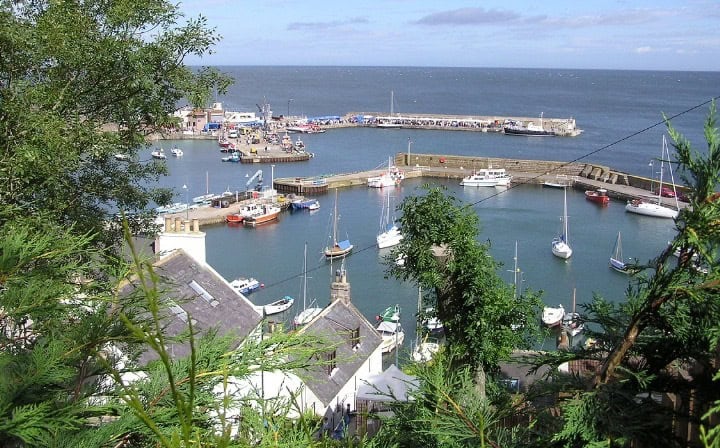
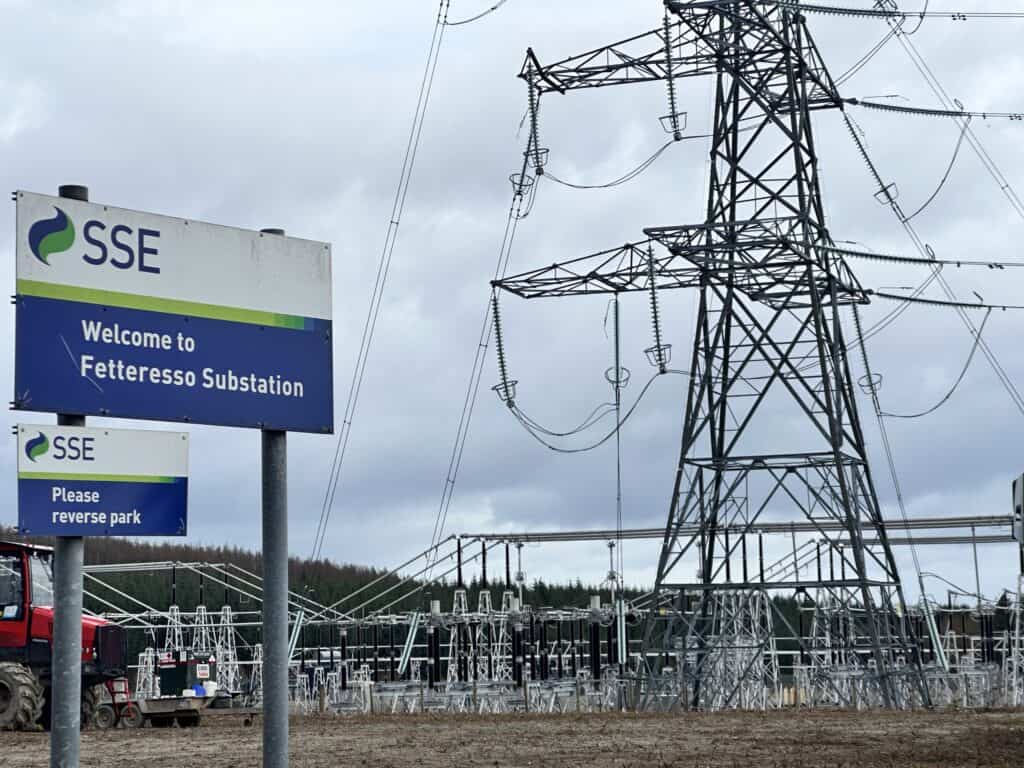
Inland, to the west is Fetteresso Forest, already home to one substation – and the site of SSEN’s proposed Hurlie substation. This massive piece of electrical infrastructure is key to the onward transmission south of ScotWind generation via the proposed Kintore to Tealing 400 kV overhead line.
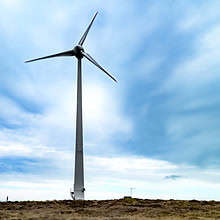
And looking seaward to the east, Stonehaven faces an array of proposed offshore wind farms each requiring their own substation in Fetteresso Forest and connection to the grid, turning forest to concrete and steel. There’s Bowdun, likely visible on the horizon, then further offshore Bellrock and Aspen.
Only now, is the town realising the extent of the encircling infrastructure – and coming to understand the possible benefits attached to the landscape shift. A second energy boom may be on the way, bringing wealth in the form of community benefits. Or maybe not.
Westminster is still deliberating its models for community benefits. The previous government consulted on the matter in 2023 but did not deliver legislation. Holyrood is constrained to guidelines, which for onshore renewable energy developments were refreshed on 16 February. A similar update for offshore developments is not expected until later this year.
For communities weighing up environmental and economic impacts of vast offshore developments, without legislation or guidelines there is only hope and guesswork. Annual payments of £6,000 per Megawatt (MW) are suggested by the Scottish Government for onshore developments. Offshore generation appears to produce less community cash per unit. Vattenfall’s Aberdeen Bay 93 MW development voluntarily offers £150,000 per annum – this works out at £1613 per MW.
Bowdun, Bellrock and Aspen Offshore Wind Farms have a combined capacity of 3.8 GW. If they are willing to match Vattenfall, the annual benefits would total over £6 million.
At least some of the chickens will hopefully hatch. The Scottish Government states: “We encourage developers to offer community benefits and shared ownership opportunities as standard on all renewable energy projects so that they deliver long-lasting, tangible outcomes for Scotland’s people and places.”
‘Tangible outcomes’ need huge amounts of planning, even when hypothetical. Stonehaven can’t just sit back and wait until the money starts landing in the Community Chest.
Local Energy Scotland manage CARES is the Scottish Government’s Community and Renewable Energy Scheme supporting communities as they engage with, participate in and benefit from the energy transition to net zero emissions.
Laura Campbell, Partnership Manager at Local Energy Scotland said: “Community benefits can bring transformational change, but it takes time for a community to come together, understand the opportunities presented by renewables developers and discuss them fully.
“To make the most of any benefits, communities need space to consult widely and plan for outcomes that create a lasting legacy for everyone. Early engagement is therefore essential. We encourage any community exploring community benefits to use our Community Benefits Toolkit as a starting point for understanding the processes involved.”
Stonehaven and District Community Council this month took its first steps to grasp the possibilities by agreeing broader support and a sub-group was needed to secure a legacy from the offshore proposals. But with no government guidance and thus far tight-lipped developers, there is clear frustration.
Chair Brian Menzies said: “Planning for benefits from offshore renewable energy benefits is a fantastic opportunity in principle. But it needs developers to engage meaningfully and to be transparent.
“Many of us are increasingly aware of onshore projects where communities are benefitting every year by hundreds of thousands of pounds, and in some cases, by millions. So where are the approaches from the developers, regarding offshore wind farms, the resulting sub-stations and pylons that then land on our shores?”
He added: “The Scottish Government consulted about community wealth building and benefit from offshore renewables in 2025. It is not clear what the outcomes of this will be, or how the impact of substations and pylons taking energy from offshore will be taken into consideration. These need to be considered in the round.”