In February 2026, the UK Government and Great British Energy launched the Local Power Plan (LPP), committing “up to £1 billion” to support community-owned clean energy, with a vision that by 2030 every community would have the opportunity to own a local energy project.
I’m pretty much the target audience for this. I run an energy transition consultancy. I’ve co-authored research for the Just Transition Commission on community benefit and the energy transition. And I live in a community in Shetland that, at this very moment, wants to do exactly what this plan says every community should be able to do.
Less than three weeks after the launch of the LPP – half-way around the world – the United States and Israel launched a war on Iran. Gas prices have surged by around 50 percent since the start of the conflict, according to the Office for Budget Responsibility (OBR). Analysts at Cornwall Insight have predicted a 10 percent rise in household energy bills from July.
This crisis, unfolding almost 3,000 miles away, is amplifying once again the structural inequity at the heart of Britain’s energy system: power is not cheap where it is plentiful, and price shocks are borne disproportionately by the people who live where power is plentiful. This inequity is felt most profoundly by those living in fuel poverty in some of the windiest corners of the nation – places like Shetland, the Western Isles and the rural Highlands.
Expanding wind power – but who benefits?
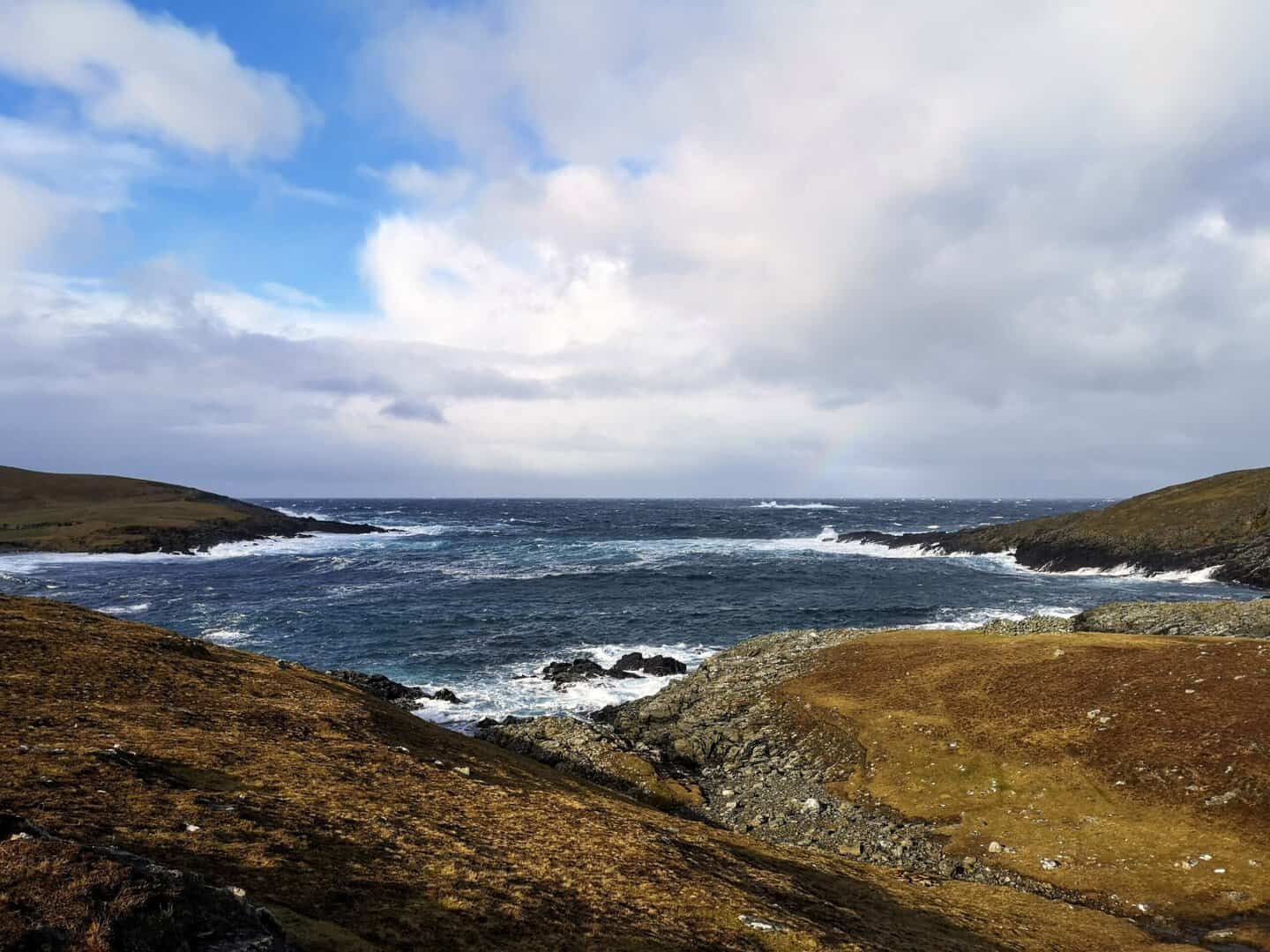
Shetland already hosts a 443 MW onshore wind farm (Viking): not quite the largest by rated capacity, but potentially the most production, given that a wind turbine in Shetland should be able to generate twice the UK onshore average. Up to 2.8 GW of proposed offshore wind sits in the Shetland pipeline, alongside a further c.280 MW of yet-to-be-built onshore wind farms, a second high-voltage direct current (HVDC) link planned for 2035, transmission pylons, battery parks, and converter stations.
The current trajectory of development involves Shetland’s wind being harvested predominantly by commercial developers, transmitted hundreds of miles south, and (where not achieving a guaranteed price under a Contract for Difference) sold at a price that is linked to the cost of gas on international markets, while the community that lives with the infrastructure is left to pay a gas-linked price for its electricity. The resource leaves, while the cost stays.
As oil prices spike and wholesale gas prices surge – they are up around 50 percent since the start of the Iran conflict, according to the OBR – households in places like Shetland are doubly exposed: once through the global price of fossil fuels, and once through the absence of any mechanism connects the wind that strips the heat from their homes to the electricity flowing through their meters.
The End Fuel Poverty Coalition has noted that the UK remains dangerously exposed to volatile international markets, and that the only lasting protection for households is to cut gas demand, expand homegrown renewables, and reform energy pricing so that bills are no longer tied so closely to global fossil fuel prices.
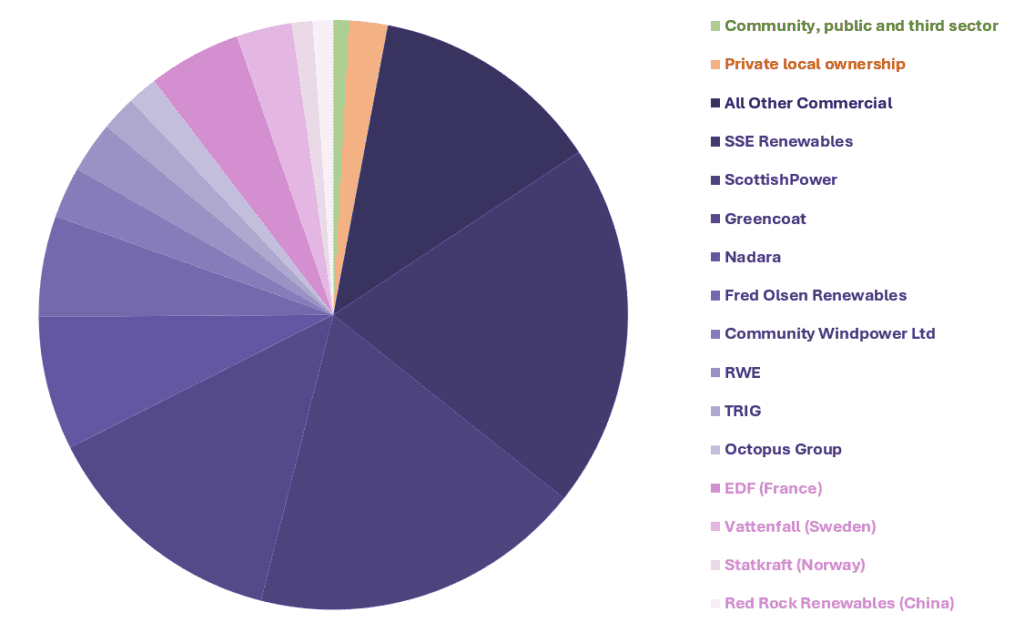
Community and local energy is still too often framed as a small-scale consent-building exercise, a sideshow to the main event of industrial decarbonisation, rather than a legitimate and scalable route to transitioning the UK energy system. As the 2024 Labour manifesto recognised, community and public ownership of the energy sector is the norm in other countries: 52 percent of Denmark’s wind capacity is community-owned, and at least 50 percent of Germany’s onshore wind capacity is citizen-owned. Meanwhile less than 1 percent of Scotland’s onshore wind capacity is in genuine community, public or third sector ownership (Figure 1).
Those most impacted by Net Zero projects are least able to develop their own
The barriers facing communities who want to develop their own energy resources are not just technical. They’re not even just regulatory. They are the cumulative result of a cascade of interlocking legal and commercial agreements that, taken together, privatise the wind resource, before community consent has a chance to be established.
Land rental agreements between developers and landowners. Grid connection agreements secured years ahead. Seabed leases awarded by the Crown Estate. Power purchase agreements. Contracts for Difference. Planning approval under rules set by national authorities. Each agreement is individually defensible. But the cumulative effect is that the right to capture the energy value of a place like Shetland has been comprehensively allocated to private developers, through processes that never included a statutory mechanism for community participation or community benefit beyond ex-gratia (voluntary) payments.
As an aside: the Scottish Government’s Good Practice Principles recommend voluntary community benefit payments of £5,000 per installed MW per year, based on a precedent established in 2010. On this basis, the 443 MW Viking project pays around £2.2 million per year into the Shetland Community Benefit Fund. In February 2026, proposals were published to raise this to £6,000 per MW – still voluntary, and still a long way short of the £7,500 or more that communities and local authorities have lobbied for.
In June 2025 alone, SSE Renewables received over £1.1 million in constraint payments for the Viking wind farm – compensation paid when the grid cannot use all the electricity produced – after nearly 78 per cent of its generating potential was curtailed. Across the first half of 2025, the company received £116 million in curtailment payments for wind farms across northern Scotland, with more than 4 TWh of potential energy left unused.
Gridlock
In England and Wales, community energy projects of up to 5 MW can now connect to the distribution grid without a Transmission Impact Assessment (TIA), following the approval of code modifications in May 2025. This means that a community group in Bristol or Barnsley can develop a meaningful project and connect it without, in essence, entering the transmission queue.
On the Scottish mainland, that threshold is 200 kW. On the Scottish islands, where I live, it’s 50 kW. The practical effect of this is that a community in England can connect a project one hundred times larger than anything a community can build in Shetland.
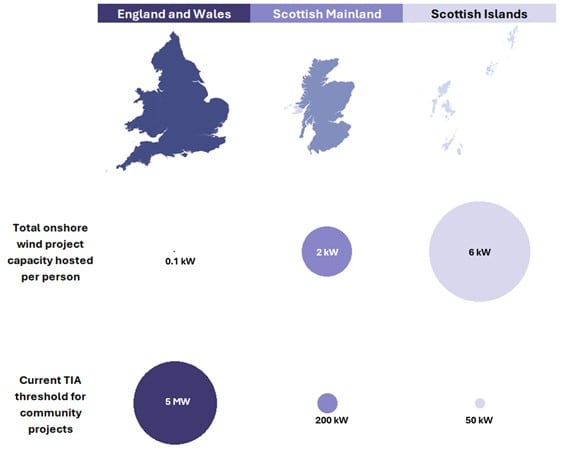
Any projects above those thresholds get drawn into the connections reform queue – the Gate 1 / Gate 2 system. The National Energy System Operator paused new applications in January 2025, and connection dates for any new projects in this part of the world are 2035 at the earliest. Remember that the original Labour manifesto committed to 8GW of community energy by 2030.
This is the thing that should trouble anyone who cares about public consent for the energy transition: the reason community projects cannot get on the grid until the mid-2030s is that the queue is full of large commercial projects, many of which have not been built yet.
This article is from our print magazine The Power Shift.
If you would like to receive a copy of The Power Shift magazine, you can order online here.
If you are interested in joining the new Environmental Journalism Network that is open to journalists, campaigners, researchers and experts, sign up here.