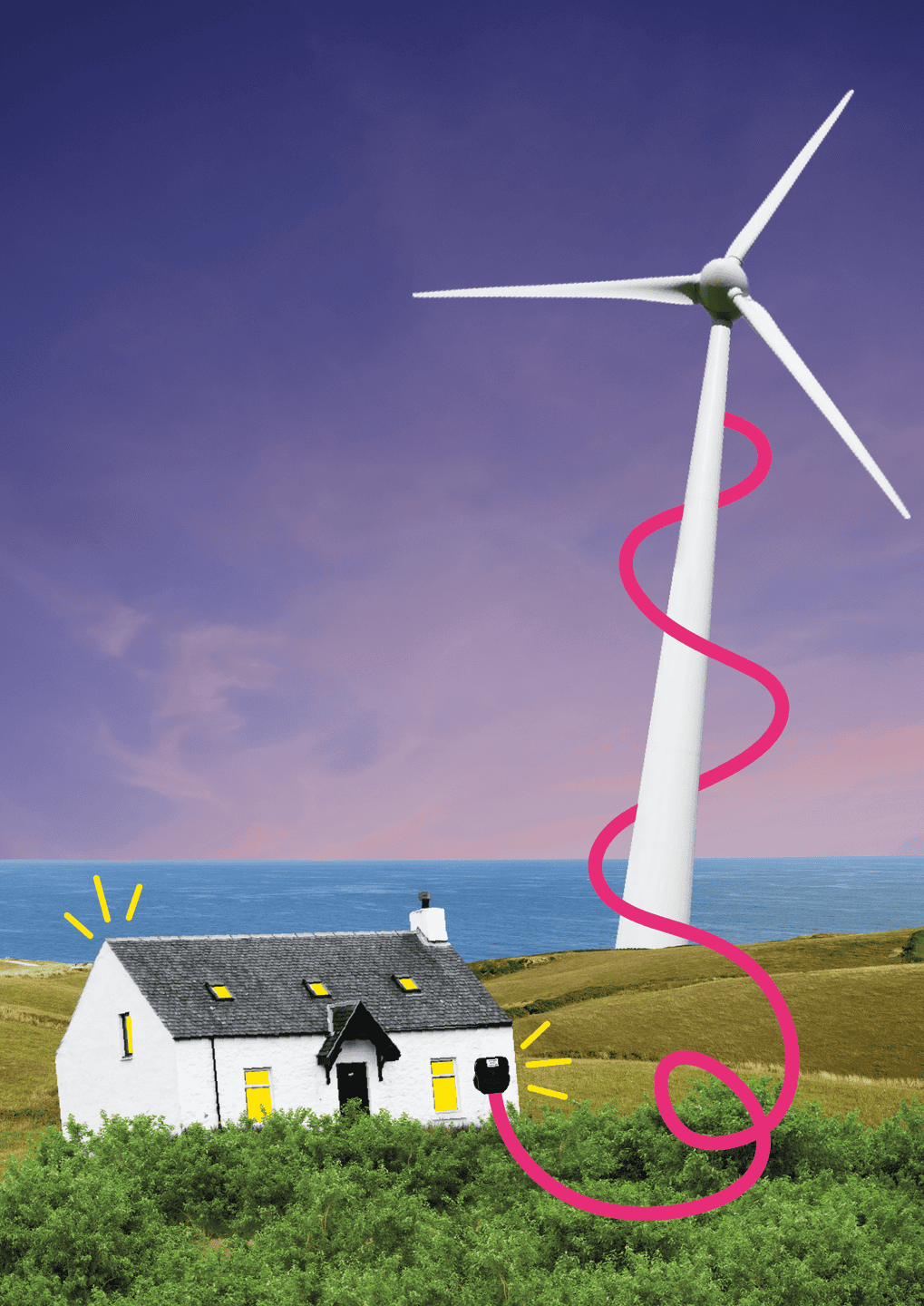
Scotland has become a world leader in wind energy. With abundant onshore and offshore wind resources, and a growing fleet of turbines delivering low-carbon power, the nation now produces far more electricity than it currently consumes. But while the generation success is real, the economic benefits too often flow out of Scotland.
If we are to secure a prosperous, net-zero future, the time has come to ask: how can Scotland retain more value from the electricity it generates? The answer lies in two complementary strategies – first, using more of the electricity locally and second, building the industries that consume it.
Use the electricity here: Unlocking local value through private wires
Scotland does not “own” its electricity. Once generated, it enters the UK-wide market and must be bought back at market rates by Scottish users – even if they’re located next to the turbine. Electricity in the UK also becomes more expensive the further it travels from the Point of Generation (POG), due to grid transmission and policy levies.
Yet there is a better way. At the base of a wind farm, electricity is effectively sold at the Contracts for Difference (CfD) strike price – around 7 pence per kilowatt-hour (kWh). If this power were fed directly into a nearby consumer via a private wire, it could be delivered for perhaps 9 pence per kilowatt-hour, including the cost of building and repaying the private wire. That is roughly 20 pence less than the grid price for Scottish industrial users, a saving that could radically cut local energy bills.
Private wire systems: Direct pathways from energy generation to consumption
This is not about subsidies. It’s about enabling access to a more sensible, cost-reflective price of energy, by simplifying the path from generation to use.
A private wire system could be extended from wind farms into every major city and town in Scotland. The implications are enormous:
- Electric vehicle charging: Public chargepoints could offer cleaner electricity at lower cost, accelerating the switch to electric transport.
- Clean industrial hubs: Industries such as green hydrogen or synthetic aviation fuel production, which are currently uneconomic at grid prices, could thrive with reliable, affordable electricity.
- District heating: The greatest win, however, is in the decarbonisation of heat.
The heating revolution: Decarbonising Scotland’s buildings – clean, cheap, and local
Heating remains Scotland’s largest source of carbon emissions. Electrifying heat is a major challenge – but also a major opportunity. Remarkably, 80 percent of Scotland’s heat demand lies within 1,000 metres of open water – rivers, estuaries, coastal zones. These are ideal for deploying large water-source heat pumps to supply low-carbon district heating networks.
If these heat pumps are powered via private wires from nearby wind farms, the resulting heat can be both clean and affordable. This would fundamentally change the economics of decarbonising Scotland’s buildings.
Instead of installing individual heat pumps, or retrofitting hundreds of thousands of flats and high-density city buildings, energy could be delivered centrally via new heat networks – especially to hard-to-heat buildings like tenements. The investment needed to decarbonise individual flats could drop dramatically. And crucially, such networks would be investible.
With a stable supply of low-cost electricity and a strategic plan for heat, private investment in heat networks could exceed billions of pounds. Every Scottish town and city could become a node in a new, modern clean energy system – with local jobs and ownership. By coupling flexible demand for electricity with variable generating capacity this also reduces the curtailment costs to the whole UK economy. Currently it costs about £1.5 billion a year just to switch windfarms ‘off’.
When it is windy we need more heat for our buildings, but in these conditions, we also generate the most electricity – so it’s a great synergy. Conversely, when conditions are less windy, it is easy to store heat to bridge this gap by using large hot water tanks – simple but effective. Unnecessary costs arise when we have too much supply (curtailment) or not having enough (balancing) as we have to switch gas-based systems ‘on’ at short notice to even things out.
Make the kit in Scotland: Industrial strategy for a net-zero economy
To capture even more value, Scotland should not only use the electricity it generates – it should manufacture the infrastructure needed to do so.
Some of this is already happening. Star Refrigeration’s factory in Glasgow built the large heat pumps now operating at Queens Quay in Clydebank. Malin Marine, also based in Scotland, builds marine infrastructure such as barges. By locating heat pumps on floating platforms (barges), scalable zero-carbon heat solutions could be rapidly deployed along rivers and coastlines – creating thousands of skilled jobs.
But the opportunity extends further:
- Pipes and distribution: District heating requires miles of large, insulated pipes. These could and should be made in Scotland.
- Pumps and exchangers: Components like circulation pumps, thermal stores, and heat exchangers are essential, and manufacturable here.
- Integration and systems engineering: The design, control and optimisation of heat networks is a valuable service export in itself.
With government guidance and procurement alignment, international firms could be encouraged to co-locate in Scotland through strategic partnerships and inward investment – especially with the support of agencies like Scottish Enterprise. A framework that records and rewards locality makes it simpler for stakeholders to follow this plan.
Policy, procurement and power: A co-ordinated national mission
What’s needed now is concerted leadership. The Scottish Government has a rare chance to define a new industry – but must act boldly. A few steps would make all the difference:
- Encourage local content in the build-out of heat networks and green infrastructure, using procurement frameworks that reward Scottish manufacturing and innovation.
- Underwrite private wire investments by local authorities or private developers. The Government cannot own the wires – but it can de-risk them by offering demand guarantees.
- Create certainty for heat network developers, particularly through strong support for the Heat in Buildings Bill.
Concerns about high costs of heat are misplaced if the model outlined here is followed. Clean heat from water-source heat pumps via private wire can be cheaper than gas – especially when spread across whole communities.
If these conditions are met, Scotland would not just reduce emissions – it would create an entire economy around clean electricity and heat. Thousands of jobs, billions of pounds in investment, and a fairer energy future would follow.
A vision within reach
The path is clear. Scotland’s wind farms already power homes far beyond our borders. But it is here, at home, where that power can do the most good – if we let it.
By rethinking how electricity is used, where it is delivered, and what industries it powers, Scotland can transform itself from an energy exporter to an energy economy.
It’s time to stop exporting value and start building it here – by heating our cities, charging our transport, powering our factories, and making the infrastructure of the future in Scotland.
This is not only an environmental imperative. It is a national economic strategy hiding in plain sight that need not be funded by the government. It just needs some creative thinking, and this costs nothing.