‘The stakes are extremely high’
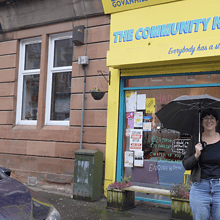
Anne Thomas, 63, lives on the Black Isle and has four grandchildren. Like any grandparent, she worries for their future.
But her concerns are a little graver than whether they’ll find a job they like or get on the property ladder. She fears that the next generation will live through climate collapse – and that Scotland will become unrecognisable.
‘I think people don’t realise the severity of what’s happening with the climate – it’s a crisis. The idea that it costs a bit too much money to tackle it now, when you look at the projections of what the economy will be like if we don’t do anything – that’s crazy. GDP will be about half of what it is now by the 2050s if we don’t tackle it properly.’
Thomas is a trustee of Highland People’s Power, a community-led organisation that hopes to boost the public’s income from renewables.
She was commenting on the launch of a scathing report from the Just Transition Commission, an independent body set up by the Scottish Government to find ways to cut emissions in a way that’s fair for everyone.
The report, the final one of its term, is titled ‘No Time to Lose’. Launched in Thurso on Thursday 19 February, it urges governments at both Holyrood and Westminster, as well private companies, to act urgently to prevent further loss of jobs, vital nature and public sympathy for climate action. It states:
“The Commission concludes that the social license for climate action is under threat and needs to be renewed. This must mean a step-change from government towards delivery that measurably improves people’s lives. Government must make maximum use of the levers it currently holds, requiring employers to act responsibly around conversion and closure, and empowering local authorities to act. Sticking with the current business-as-usual scenario risks building a country where people continue to live in some of Europe’s leakiest buildings, and endure high levels of fuel poverty, deepening job insecurity and in-work poverty, and the undermining of efforts to reduce child poverty. It risks worsening rural depopulation at precisely the moment that we need to ensure communities in rural and island areas have the services and support they need to deliver much of the infrastructure and new forms of economic activity that will underpin the transition and its economic upsides for all of Scotland. Unless we renew our ambition and redouble our efforts, the enormous opportunity – both for meaningful climate action and for building a fairer and more prosperous country – will be lost.”
Richard Hardy, Prospect’s National Secretary for Scotland and Northern Ireland and a commissioner since 2019, said at the event: ‘There can’t be any more Grangemouths. There can’t be any more Mossmorrans. We’ve only got another election cycle to get this right.’
He said that without quick action, public backing for a shift away from fossil fuels would falter; and workers would give up on the movement.
‘They will commit political suicide by voting for people who will tell them what they want to hear, rather than those who will deliver change,’ said Hardy. He made reference to Sir Jim Ratcliffe, the owner of Ineos which recently ceased operations at Grangemouth with the loss of around 400 jobs: ‘If we let the tax dodging millionaires off, people like the tax dodging millionaire will form the next government. No-one is getting this right. But we have to, because if we don’t the world becomes massively more unequal.’
The current Just Transition Commission has been running since 2021, and its term will end this year along with the current parliament. Commissioners travelled the length and breadth of Scotland to hear from members of the public about their views on energy, employment, nature and the environment.
Commission co-chair Satwat Rehman also heads up One Parent Families Scotland. She said that the government needed to be ‘front-footed and courageous’ to tackle future challenges.
‘Around one in three households are in fuel poverty. College funding has fallen by 22% in real terms since 2022.
‘There are some regions hosting far more infrastructure and producing far more energy than others, so there is a risk in us building new inequalities. We need to find those mechanisms that are going to work for everyone.’
For Thomas, the need for fairness as Scotland ramps up its renewable energy output is vital. She said that while public debate around a just transition has tended to focus on Aberdeen and the North East, the transition also affected communities like hers in the Highlands and Islands.
‘The vast majority of our infrastructure is owned by foreign multinationals and foreign governments – they are getting the benefits, and local people in Scotland generally are not. That’s a really important part of the just transition.’
Many offshore workers come home to the Highlands, she added, and called for their skills to be redeployed to tackle the climate crisis, rather than being left to the dole.
‘We do have a bit of a chance now to mitigate the worst of the climate crisis. We have a chance of redeploying some of the skilled people who have worked in fossil fuels to tackle the crisis we’re facing, or we could just throw them on the dole and completely fail.’
Read the Just Transition Report here: No Time to Lose: Final Report of the 2nd Just Transition Commission (2026) – Just Transition Commission