A surge of wind farm proposals
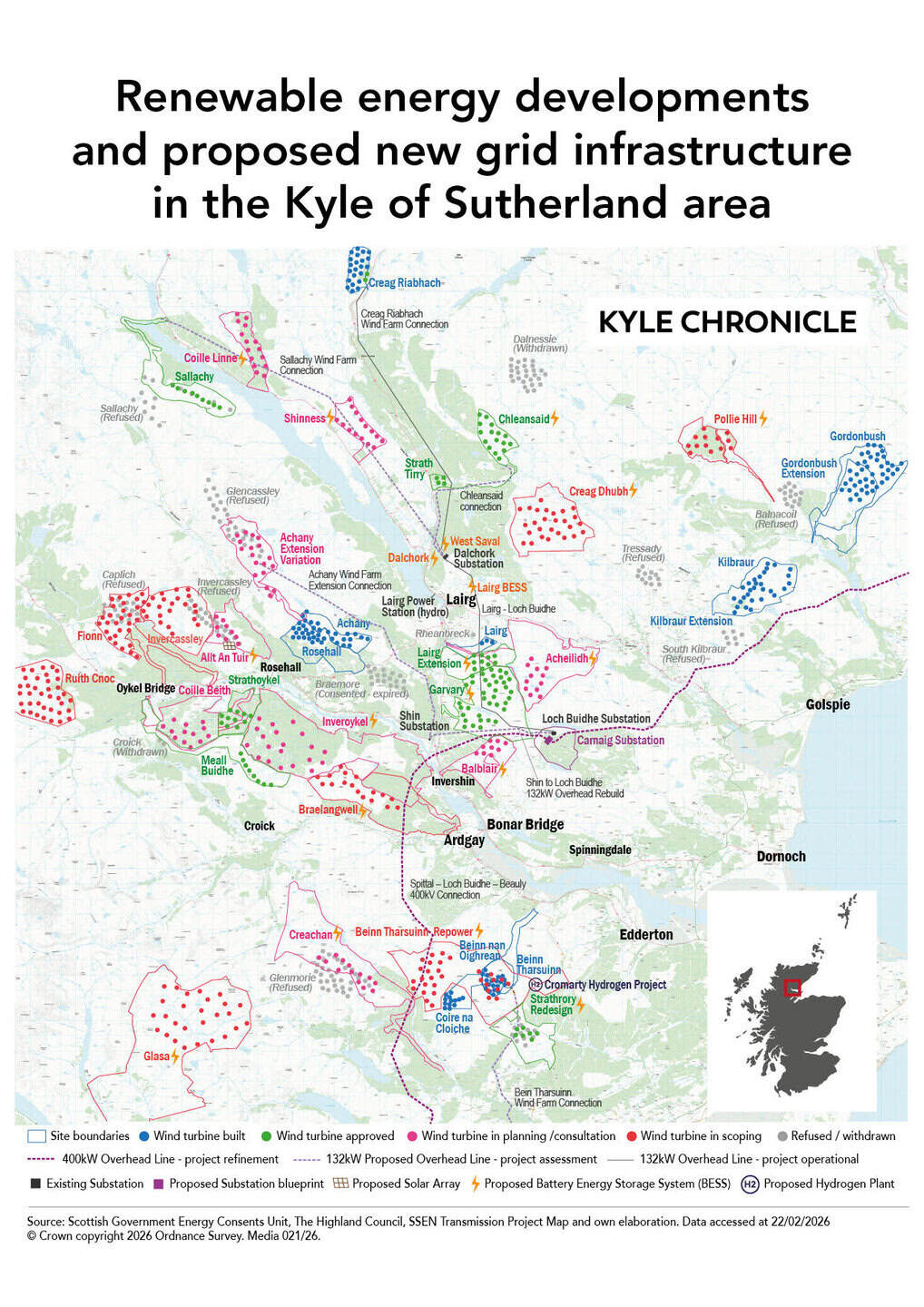
In June 2025, Kyle Chronicle mapped all wind farm developments that were built, approved, or in planning or scoping stages across the Kyle of Sutherland and surrounding areas.
Seeing the full picture of what is planned is striking. For the first time, every proposed development can be viewed together, revealing how dramatically the landscape could change – with what appears to be wind turbines on almost every hill.
The map revealed the scale of change facing communities in central and south Sutherland and Easter Ross. In recent years, residents have faced a relentless stream of applications, appeals, and reapplications, alongside a planning process that seems designed to bypass local democracy.
Since June 2025, eight additional wind farm proposals have appeared on the Energy Consents Unit (ECU) website. Of the 19 proposals for the Highland Council region, eight are in our area, including three entirely new sites: Fionn (on the site of the previously refused Caplich project), Ruith Cnoc west of Oykel Bridge, and Creag Dhubh north-east of Lairg.
These newly proposed developments bring the total turbines projected or approved to 402, potentially generating over 3 GW – almost ten times the 172 turbines already operating locally, which have a combined installed capacity of 384.5 MW. The new turbines would be taller, reaching 150–250 m, compared with the existing 80–150 m range.
A project is logged on the ECU website when it first enters scoping, when it moves into the formal planning consultation stage, or when developers seek to alter an already-approved scheme through a variation.
Why here
What makes our area so attractive to renewable energy developers? Wind, of course – but perhaps more telling would be to ask what it doesn’t have.
It doesn’t have extensive protected areas, such as the Flow Country, or a National Scenic Area such as Wester Ross or the Dornoch Firth. It doesn’t have large towns. It doesn’t have many elected representatives at Westminster, with just one MP, or indeed many people living here.
Another thing that it doesn’t have is grid infrastructure, and this matters.
Planning authorities assess applications independently of the infrastructure needed to connect them to the grid. A development cannot go ahead unless a grid connection is secured.
Meall Buidhe Wind Farm, approved in June 2023 by the Scottish Government overruling Highland Council, has now been granted a three-year extension until 2029 to accommodate a delayed grid connection. Under normal conditions, developers must start construction within three years of approval.
Previously, developers could expect the grid to be extended to their site, regardless of distance from existing infrastructure or energy use. This first-come, first-served system created significant delays, with some projects now waiting 10–15 years for a connection.
In December 2025, the National Energy System Operator (NESO) announced reforms to tackle “zombie” projects blocking the queue. The most advanced or strategically important schemes are prioritised for delivery by 2030 or 2035, while others that do not meet readiness or strategic criteria are not given a connection date. Among the non-priority projects are 152.9 GW of battery storage and 13.4 GW of onshore wind.
Planning and grid applications often happen years apart, resulting in “salami-slicing,” where developers submit separate applications for parts of the same project.
Grid and legal challenges
In February 2026, judges at the Inner House of the Court of Session overturned the Wull Muir project in the Moorfoot Hills. The scheme failed to include details of the off-site grid connection needed to export electricity, meaning the Scottish Government reporter could not fully assess environmental impacts.
Initially refused by the Scottish Borders Council in 2020, Wull Muir was approved in 2025 by a reporter who concluded it did not break planning law. A local farm challenged the decision. In their written judgement, the judges said:
“The reporter was entitled to assess the proposed development on its own merits and on the assumption that a grid connection would be provided at a later date. That does not… address the irrationality of addressing only the merits and not the demerits of the anticipated completed development.”
This ruling could be a gamechanger.
Grid connections and reinforcements are also behind controversy over SSEN’s proposed 400 kV lines and substations. Highland Council objected to the overhead line from Spittal to Beauly in November 2025, rejected the 400 kV Carnaig substation near Bonar Bridge (24 football pitches) in December, and voted unanimously against the 400 kV Fanellan substation near Kiltarlity (37 football pitches) in February 2026.
These rejections come despite SSEN being the first business to sign the Highland Social Value Charter, committing £7,500 per MW to a regional fund, on top of £5,000 per MW guidance from 2014. Westminster and Scottish Governments are consulting on mandatory community-benefits schemes, but critics argue proposed rates do not keep pace with inflation.
Planning procedures add complexity: a wind farm and its grid connection (and related infrastructure, like access roads) often require separate applications years apart. Developers can submit variations to already-approved projects, and Environmental Impact Assessment Reports (EIARs) may be prepared without an established grid connection.
Communities push back
Sutherland resident Bill Lockyer attended the Convention of Community Councils at Holyrood on 24 February 2026, representing Creich and Ardgay & District Community Councils. Arranged by Highland councillor Helen Crawford, the event discussed the Unified Statement from a June 2025 convention in Inverness.
The statement calls for moratoriums on major applications, a planning inquiry to address cumulative impacts, and a national energy policy. 65 delegates attended from across Scotland, including the Highlands, Borders, Dumfries & Galloway, South Lanarkshire, Ayrshire, East Lothian, and Aberdeenshire. MSPs, including Cabinet Secretary Gillian Martin, were also present.
Ms Martin said there would be no moratorium and no planning inquiry commission, but she would listen to suggestions to improve planning so communities could benefit more.
Lockyer said:
“I was disappointed that Ms Martin only stayed for 30 minutes and at her lack of engagement with the convention… All who spoke supported the ideas of a moratorium on such infrastructure developments, and the creation of national energy policy.”
“I did get called to speak for the allotted 3-minute slot and commented upon the fantasy of the developers’ carbon-saving calculations, traffic movements on abnormal indivisible loads duration of impacts on a particular location, and contaminants ie heavy metals, Cs-137, sedimentation and those from an out-of-process BESS.”
“Disappointed as I was at the engagement at a senior level from the Scottish Government, there is a groundswell from community councils wishing to take part in the convention to influence the current renewable energy free-for-all that is presently taking place.”
“Helen’s closing remarks were that it was easy to pick off isolated rural communities, but here the south, northeast and The Highlands had combined with more to come. We are not going away. The Scottish Government needs to get a grip and deal with it.”
Tisi Dutton, spokesperson for No Ring of Steel Kyle of Sutherland (NORoS), added:
“It’s heartening that progress is being made towards communities, through the Community Council’s Convention, becoming Planning Stakeholders in developmental discussions, which will create the important forthcoming Strategic Spatial Energy Plan. It is vital for local voices to be heard so that democracy is respected, because the strong feeling is that they are being dismissed and considered irrelevant.”
“This is compounded by the Energy Consents Unit’s (ECU) decision to refuse emails in response to developers’ applications for windfarm and BESS developments.”
In January 2026, the Energy Consents Unit removed email as a method for submitting public objections, replacing it with postal submissions or the ECU portal. Critics say the website can be unreliable, and some have alleged the change was meant to limit AI-generated comments, though Scottish Ministers confirmed that “members of the public remain free to use any tools or resources to help formulate their views.” The new system is intended to reduce backlog, log all submissions, provide instant confirmation, and protect personal data.
Some have also criticised the 37,000-character limit on submissions, which they say restricts their ability to present a full analysis of Environmental Impact Assessment Reports (EIAR), leaving many feeling their detailed concerns cannot be properly registered.
Dutton continued: “The NESO reforms concerning grid connection backlog are welcome. Currently, an established grid connection is not needed when an EIAR is prepared for proposed developments, and connection is subject to a separate application, often months or even years later. It means that developments can be built without a realistic plan for connecting the energy produced to the grid. This is an untenable situation and shows how the current system favours developers and the landowners who host them.”
Looking at the bigger picture
Given developments on such an extraordinary scale, one might reasonably expect equally extraordinary benefits for communities hosting them. But without a clear overall plan, it remains uncertain how the beneficiaries of this energy “gold rush” will compensate rural communities for the industrialisation of their land.
This article is from the print edition of our magazine The Power Shift.
If you would like to receive a copy of The Power Shift magazine, you can order online here.
If you are interested in joining the new Environmental Journalism Network that is open to journalists, campaigners, researchers and experts, sign up here.