As the chokehold of over-extended supply chains for shipping massive amounts of fossil fuels is brutally exposed in the Straits of Hormuz, the technologies and scale and reduction of cost of renewables are accelerating at an astonishing pace. Battery storage costs hit record lows, China’s BYD company are to launch new premium EV in Europe that can charge in minutes with a range of up to nearly 500 miles, alternatives to Lithium batteries are emerging, and, as Sarah Ade and Keith Brander explore elsewhere, the potential for innovation in hydro power storage is huge.
As the ramifications of an energy crisis that puts the 1970s in the shade are felt all around the world, the reality that Net Zero will protect the UK from fossil-fuel shocks is being realised. The old canard about ‘why should we do something here when China is polluting so much’ is redundant, China is adopting green energy at a scale hard to imagine for many other countries, installing 446 gigawatts of it in 2025 – more than the rest of the world combined, according to Australian think tank Climate Energy Finance.
There’s a paradox here that place matters.
Just as the madness of oil dependency comes into brutal focus Hans Marter and Erin Rizzato Devlin write:
“Despite hosting one of the largest and, allegedly, the most productive, onshore wind farms in the UK, fuel poverty levels are rampant while the cost of living is 20-65 percent above the rest of the UK mainland.
“And it’s the same wind-producing load factors of 50 percent for the wind industry that sucks the heat out of Shetland’s homes. The effect of that persistent bone-chilling wind – January 2026 was a particularly good example of that – needs to be experienced to be fully understood.”
And as Sylvia Muras from the Kyle Chronicle points out:
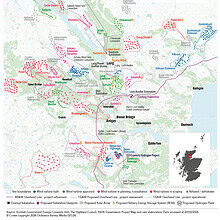
“Seeing the full picture of what is planned for our area is striking – perhaps for the first time, we can view every proposed development together and understand how dramatically it will reshape the landscape, with what appears to be wind turbines on almost every hill.”
“Given developments on such an extraordinary scale, one might reasonably expect equally extraordinary benefits for the communities that host them. But, if it’s unclear whether an overall plan for all these developments exists, it’s even more uncertain how the beneficiaries of this energy “gold rush” are going to compensate rural communities for the industrialisation of their land.”
Convergence
It’s into this space of contradictions that a convergence of projects and campaigns are coming together, such as Our Power – a campaign from Community Energy Scotland, Friends of the Earth Scotland, Future Economy Scotland, Platform, Stop Climate Chaos Scotland, and Uplift. They state: “Communities are seeing wind turbines go up, but see the profits going elsewhere. Workers were promised jobs from the shift to clean energy, but too many are still waiting.”
They are calling on the next Scottish Government to ensure that local communities share in the wealth generated here – not just private companies, overseas investors, and shareholders. They propose:
“A simple and fair way to do that is by taking a public stake in future projects. A 20 percent equity share funded through bodies like the Scottish National Investment Bank.”
They highlight the benefits of community-owned energy:
“Community-owned energy projects are already delivering an income stream for local services, skills for local people, as well as local pride to parts of Scotland, but many more communities could see these benefits. In Denmark, two-thirds of onshore wind is community-owned whereas in Scotland, it’s currently less than 1 percent, because of needless barriers. The next Scottish Government can change that with more ambition, a proper roadmap, and more support for communities. It’s time to stop locking communities out and start giving them a meaningful stake in our energy future.”
This complete disjuncture between the opportunity of the renewables revolution and the reality on the ground is also reflected on in the Just Transition Commission’s final report, No Time to Lose, in which they conclude that:
“The social license for climate action is under threat and needs to be renewed. This must mean a step-change from government towards delivery that measurably improves people’s lives. Government must make maximum use of the levers it currently holds, requiring employers to act responsibly around conversion and closure, and empowering local authorities to act.
“Sticking with the current business-as-usual scenario risks building a country where people continue to live in some of Europe’s leakiest buildings, and endure high levels of fuel poverty, deepening job insecurity and in-work poverty, and the undermining of efforts to reduce child poverty. It risks worsening rural depopulation at precisely the moment that we need to ensure communities in rural and island areas have the services and support they need to deliver much of the infrastructure and new forms of economic activity that will underpin the transition and its economic upsides for all of Scotland.
“Unless we renew our ambition and redouble our efforts, the enormous opportunity – both for meaningful climate action and for building a fairer and more prosperous country – will be lost.”
Such energy and analysis can be found springing up in many places as the collective wisdom converges on the same routes out of our predicament.
The Scottish Community Coalition on Energy has published a manifesto stating:
“To build public support for renewables and the energy transition, we must enable and support increased community ownership and shared ownership of new and existing electricity and heat infrastructure, and fair distribution of the wealth that is being generated and consolidated through renewables.”
Such manifestos and demands now surround the Scottish Parliament, reflecting the deep concerns of rural communities but also the path to navigate beyond such a bourach.
This last year saw key legislation passed at Holyrood, including the the Ecocide (Scotland) Bill, placing Scotland on track to become the first UK nation to criminalise severe environmental destruction, Scotland’s Natural Environment Bill, which will require the Scottish government to set legally binding targets to restore Scotland’s nature, and the Community Wealth Building (Scotland) Bill.
These are necessary but inadequate shifts. They are signposts rather than destinations. But they are also a reminder of the return of the importance of ‘place’. As Neil McInroy has written about the Community Wealth Building legislation:
“A key part of this shift is a return to place‑based economics in which we use what we have more effectively – our people, our scarce public resources, our land, institutions, and productive capacity. This is about improving productivity not only by growing sectors but by strengthening the systemic relationship between economic activity, place, and ownership. Our future productivity depends on how economic sectors are even more deeply rooted in inclusive ownership models that deeply relate to the communities and regions around them.”
Beyond Policy
But beyond the idea of new policy, there lies deeper questions.
The Scottish renewables revolution feeds into a dysfunctional, even dystopian UK energy system. The crisis in the Highlands and Islands has echoes of age-old issues of power, poverty and democracy.
The story has echoes John McGrath’s seminal 1970s play, The Cheviot, the Stag and the Black Black Oil, which traced economic change in the Scottish Highlands – from the Clearances of the 19th century to the contemporary oil boom at the time of its first production. Following in this vein, the Spring Consortium of artists, researchers, and thinkers presented an experiment in ‘ceilidh theatre’ at the Celtic Connections festival, exploring the themes of The Power Shift.
The echo is of communities without agency facing enormous changes over which they have little or no control. The story holds the same questions: who is the Highlands for, and what is the purpose of energy production?
We have a crisis of over-abundance of supply alongside people in the coldest parts of the UK unable to adequately heat their homes.
If we stand back from this crisis, we see that the problem is one of gigantism, an addiction to growth, and an inability to stand up to corporate power. The onshore renewables industry is vast – frequently foreign-owned – and far distant from the demand it is supposed to supply, leading to massive costs of distribution.
It’s becoming very clear that energy infrastructure, like political power needs to be radically decentralised.
We need to radically re-think who and what energy is for. We need to democratise energy and liberate technology. We need to re-imagine energy as a public resource rather than a private commodity.
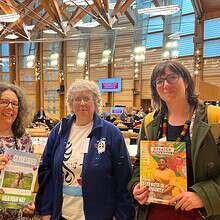
This article is from the print edition of our magazine The Power Shift.
If you would like to receive a copy of The Power Shift magazine, you can order online here.
If you are interested in joining the new Environmental Journalism Network that is open to journalists, campaigners, researchers and experts, sign up here.